
Free AI Doctor: What It Can (and Can’t) Do, Best Options, and How to Use One Safely
An AI-powered health tool can help you understand symptoms, lab results, or a general health question in plain language — free, instant, and private. That’s exactly what a free AI doctor does. According to MedlinePlus, it is not a diagnosis and not a replacement for a licensed physician; it is a helper that explains and prepares you for a real appointment.
This guide covers which free options actually work, how accurate they are, what happens to your data, and exactly when you should stop typing symptoms and call a real clinician — or 911.
Medical disclaimer: This is not medical advice and not a substitute for a licensed physician’s diagnosis or treatment. In a medical emergency, call 911 (US). In a mental-health crisis, call or text 988 (Suicide & Crisis Lifeline).
What is a free AI doctor?
A free AI doctor is a web or chat tool built on a large language model (an LLM in the GPT class) that takes your description of symptoms, a lab value, or a general health question and returns a plain-language explanation plus a list of possible causes and next steps. It behaves like an AI health assistant or AI medical chatbot, not a licensed clinician.
An AI health assistant, not a physician
Dr.Khan AI, for example, answers within seconds and requires no signup at all. WebMD is more direct about the mechanics behind its own symptom checker, disclosing that its tool «may leverage certain generative AI tools.» Under the hood, most free AI doctors and AI symptom checkers run on the same class of large language model that powers general-purpose chatbots — trained further on medical text so it can talk about symptoms, medications, and test results in a structured way. What it produces is a differential: a ranked set of possible explanations, not a verdict.

That distinction matters for how you should read the output. An AI health assistant is closer to a well-read reference librarian than to a doctor with a stethoscope — useful for organizing what you already know, unable to examine you or confirm anything.
What it typically does — and returns
Across the free tools people actually use, the core feature set is narrow and consistent:
- Symptom checker — you describe what you feel, it returns a list of possible causes ranked by likelihood, sometimes with an urgency flag.
- Lab and term explainer — paste a result or a word from your chart, get a plain-language explanation of what it usually means.
- Medication questions — what a drug is for, common interactions, and what to ask your own doctor before starting or stopping it.
- Visit prep — it turns your symptoms and history into a short list of questions and talking points for your next appointment.
None of these four outputs is a diagnosis. Every one of them is a starting point for a conversation with a licensed physician.
Best free AI doctor and symptom-checker options in 2026
The tools currently ranking for «free ai doctor» split into two groups: services that are free with no catch, and services where the AI chat is free but a human upgrade costs money.
Free, no-strings symptom checkers
Ubie runs a symptom check in about three minutes with no credit card, built on more than 50,000 clinical sources and supervised by over 50 medical experts. Docus offers a free basic symptom check, with its outputs validated by a panel of 350-plus doctors and data handled under SOC 2, HIPAA, and GDPR compliance. DxGPT is run by the nonprofit Foundation 29 and funded through grants and donations rather than subscriptions, with a focus on differential diagnosis support for complex and rare conditions. WebMD’s Symptom Checker asks about your symptoms and discloses that it «may leverage certain generative artificial intelligence tools to generate results.»
«Free» AI doctors with a paid human upgrade (freemium)
Several tools that market themselves as a free AI doctor are really a free AI chat with a paid human layer on top. Doctronic’s chat is free, but a video visit with a licensed doctor — available across all 50 states plus DC — costs $39. Counsel Health gives you its AI assistant at no cost, then charges $29 to add a real physician who typically replies within 15 minutes for a 7-day visit window; it’s restricted to users 18 and older and isn’t available in every state. CodyMD advertises a prescription from a licensed physician within about an hour, which is a paid step layered on top of its AI chat. Dr.Khan AI is the outlier here — its entire service, including anonymity and no registration, stays free.
| Tool | Free tier? | Human upgrade | Privacy notes | Best for |
|---|---|---|---|---|
| Dr.Khan AI | Fully free | None | No signup, no PII, ephemeral sessions | Quick, anonymous check |
| Ubie | Fully free | None mentioned | Expert-supervised | Fast symptom triage |
| Docus | Fully free basic check | Optional paid plans | SOC 2, HIPAA, GDPR | Privacy-conscious users |
| DxGPT | Free (nonprofit) | None | Grant-funded, nonprofit | Complex/rare symptoms |
| Doctronic | Free chat | $39 video visit | — | Wanting an actual visit |
| Counsel Health | Free AI | $29 for 7-day doctor access | 18+ only, not all states | Fast human follow-up |
| CodyMD | Free chat | Paid prescription (~1 hr) | HIPAA | Needing a prescription fast |
The pattern across nearly every listing is the same: «free» almost always covers the AI conversation. The moment a prescription, a video call, or a licensed signature enters the picture, a human clinician — and usually a fee — is involved.
How accurate are AI symptom checkers?
Accuracy varies by tool, and even the best results describe a list of possibilities, not a confirmed answer.
What the evidence shows
A 2024 study on medRxiv found that Ubie’s symptom checker reached a 71.6% top-10 hit accuracy, noticeably ahead of the roughly 60% average accuracy seen across competing tools in the same comparison (medRxiv 2024.08.29.24312810). That’s a meaningful improvement over earlier symptom-checker generations, but «top-10 hit accuracy» means the correct cause showed up somewhere in the top ten suggestions — not that it was ranked first, and not that a physician confirmed it. Large language models can also state an incorrect cause with the same confident tone as a correct one, a known failure mode sometimes called hallucination.
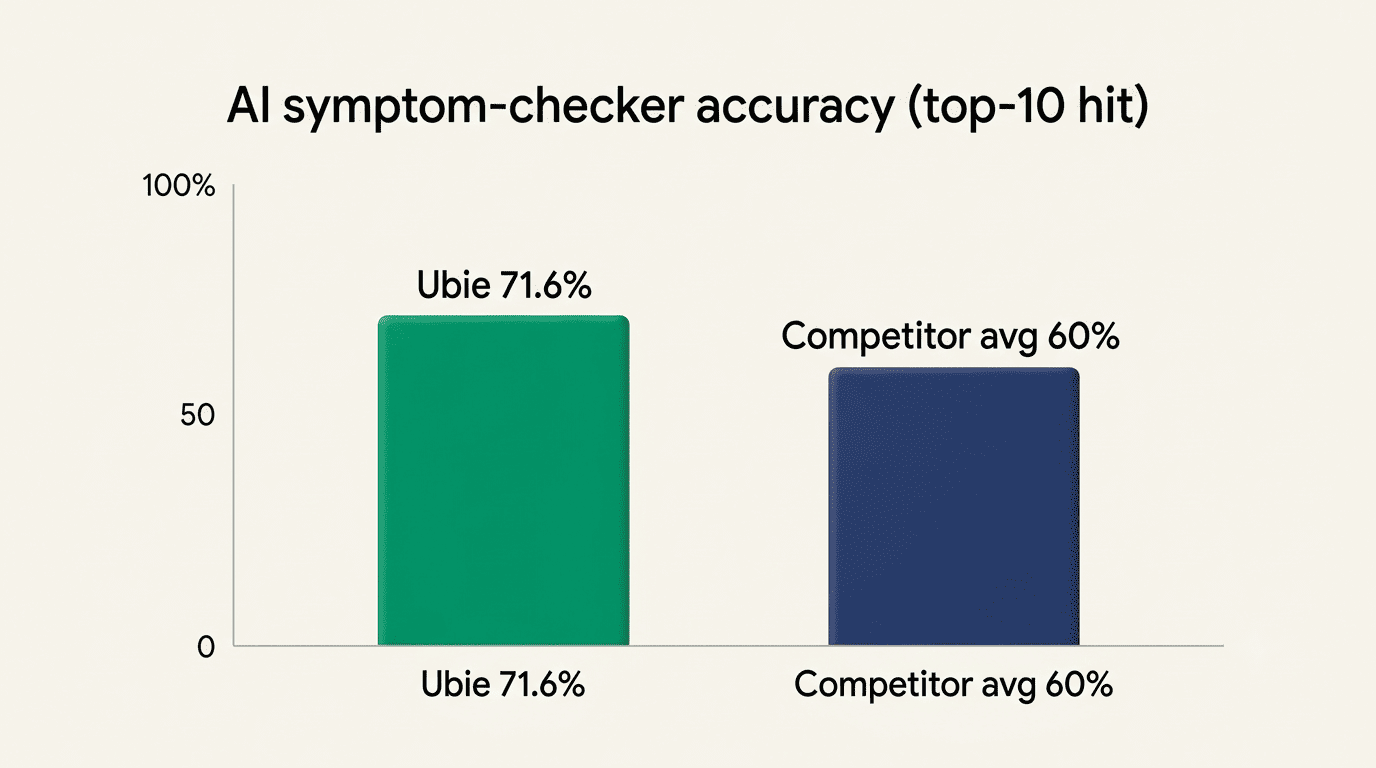
The FDA tracks AI and machine-learning software used in medicine precisely because outputs like these need ongoing oversight, not a one-time accuracy score:
Artificial intelligence (AI) and machine learning (ML) technologies have the potential to transform health care by deriving new and important insights from the vast amount of data generated during the delivery of health care every day.
U.S. Food and Drug Administration
Why AI can’t confirm a diagnosis
An AI symptom checker never examines you. It can’t listen to your lungs, order blood work, look at a rash under proper lighting, or notice something you didn’t think to mention. It works only with what you typed. A real diagnosis requires a physical exam, and often lab or imaging results, interpreted by a licensed physician who can ask follow-up questions in real time. The most reliable way to use an AI doctor’s output is as a list of questions to bring to that appointment, not as an answer to stop at.
Is a free AI doctor safe and private?
Privacy practices vary widely between tools, so it’s worth checking before you type anything sensitive.
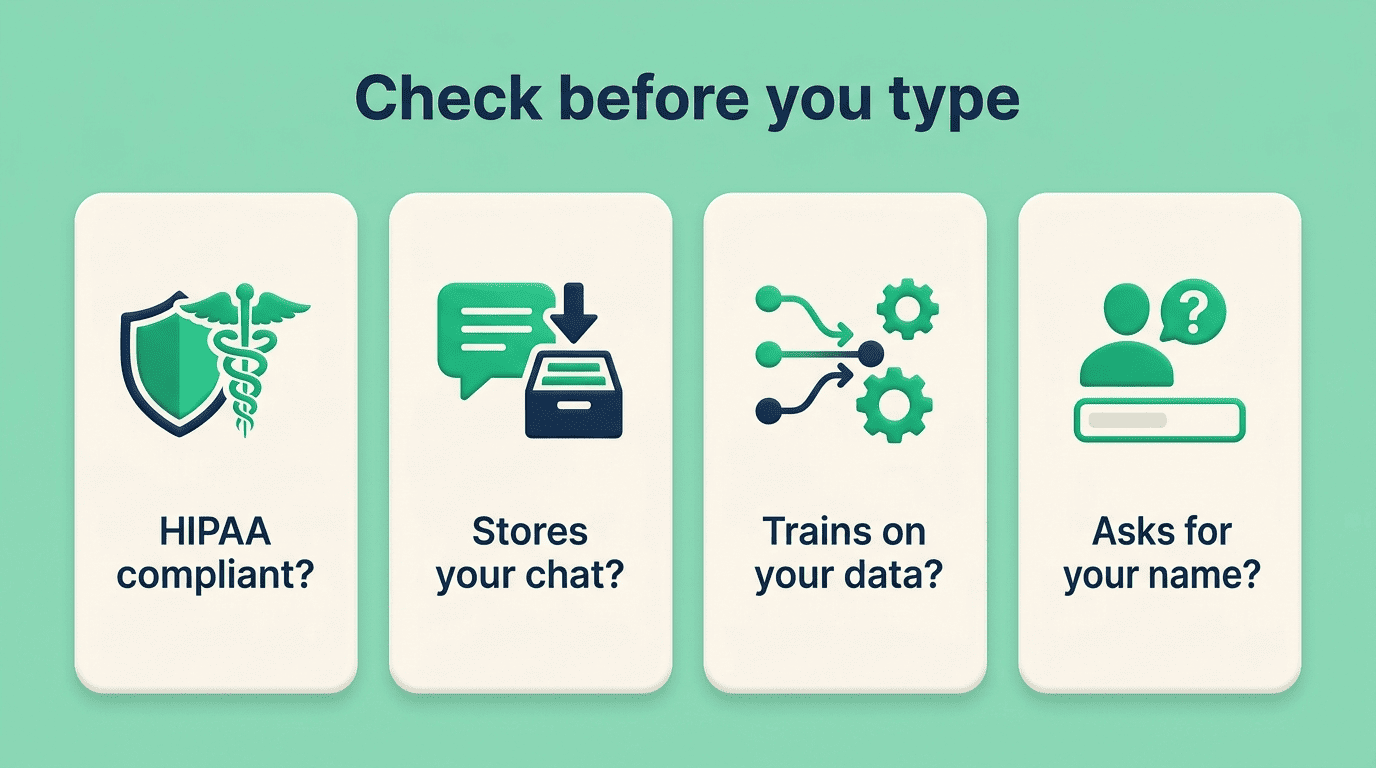
Data handling differs by service. Dr.Khan AI (18+ only) collects no personally identifying information beyond the age and sex you optionally enter, and its sessions are ephemeral — each consultation expires immediately after the conversation ends. Docus, by contrast, states compliance with SOC 2, HIPAA, and GDPR, which means it retains and protects data under formal security and privacy frameworks rather than discarding it. The Wellness commits to GDPR compliance and states that it never uses chat data for AI training without consent. Before you share anything personal, check whether the specific service is HIPAA-compliant, whether it stores your conversation, and whether that data trains future models — and avoid entering your name or other identifiers unless the tool actually requires them.
Regulatory approval is the exception, not the rule. Most free AI doctor chat tools are not FDA-cleared medical devices; they position themselves as general information or education, which carries a lower regulatory bar than a diagnostic device. DxGPT is a partial exception — its professional-tier product is classified as a Class IIa medical device software under the EU Medical Device Regulation 2017/745 (Rule 11), a stricter European framework than what applies to most free consumer chat tools. In practice, an unregulated «free» label is common; reading each tool’s own disclaimer is the only reliable way to know what you’re actually using.
Can an AI doctor diagnose or write a prescription?
Diagnosis: no — possible causes only. No AI doctor tool issues an official diagnosis. What it produces is a differential — a ranked list of plausible explanations for your symptoms. Converting that list into an actual diagnosis is a step only a licensed physician can take, and it normally requires an exam.
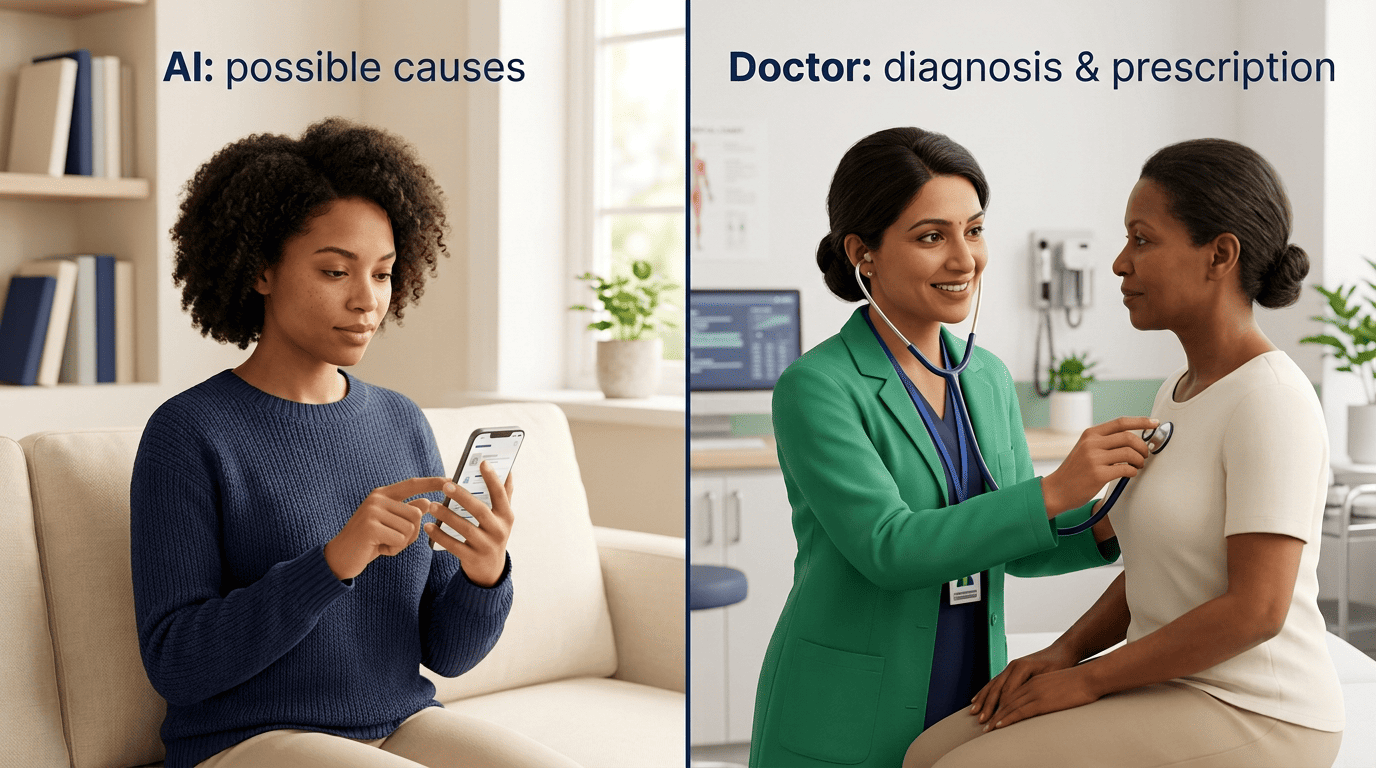
Prescriptions: only a licensed clinician can write one. When a service like CodyMD advertises a prescription within about an hour, or Doctronic and Counsel Health mention prescriptions at all, the medication order is written by a real, licensed human clinician after review — never by the AI model itself. Counsel Health is explicit that it does not prescribe controlled substances and restricts its service to users 18 and older. If a tool implies the AI itself is prescribing, that’s a signal to read the fine print more carefully.
When to skip the AI and see a real doctor (or call 911)
An AI symptom checker is built for non-urgent questions. Certain symptoms should never go through a chatbot first.
Emergency red flags — call 911 now, not an app
According to guidance from the CDC and Mayo Clinic’s first-aid resources, the following signs mean you call 911 immediately, not open an AI chat:
- Chest pain or pressure
- Trouble breathing or shortness of breath
- Sudden weakness or numbness, especially on one side of the body
- Face drooping, arm weakness, or slurred speech — the classic stroke warning signs (think FAST)
- Severe or uncontrolled bleeding
- Sudden, severe headache unlike any before
- Fainting or loss of consciousness
- A severe allergic reaction (throat swelling, difficulty breathing)
None of these belongs in a symptom checker. Every one of them belongs to an ambulance call.
Mental-health crisis — call or text 988
If you’re having thoughts of self-harm or suicide, or you’re in an acute mental-health crisis, contact the 988 Suicide & Crisis Lifeline by calling or texting 988. An AI chat, free or paid, is not built or staffed to handle a crisis in real time — 988 connects you to a trained crisis counselor instead.
See a clinician (not urgent) when
Some symptoms don’t need 911, but they do need a real appointment rather than another round of AI chat:
- Symptoms lasting more than a few days or steadily getting worse
- A high or persistent fever
- Any symptom in a child, an older adult, a pregnant person, or someone with an existing chronic condition
- Any «red flag» phrase that shows up in the AI’s own output
An AI doctor is genuinely useful here — for turning the symptom list into a clear, organized set of talking points before you walk into that appointment.
How to get the most from a free AI doctor
The quality of what you get back depends heavily on what you put in. Vague input produces a vague differential; specific input produces a genuinely useful one. You can try this directly with an ai doctor.
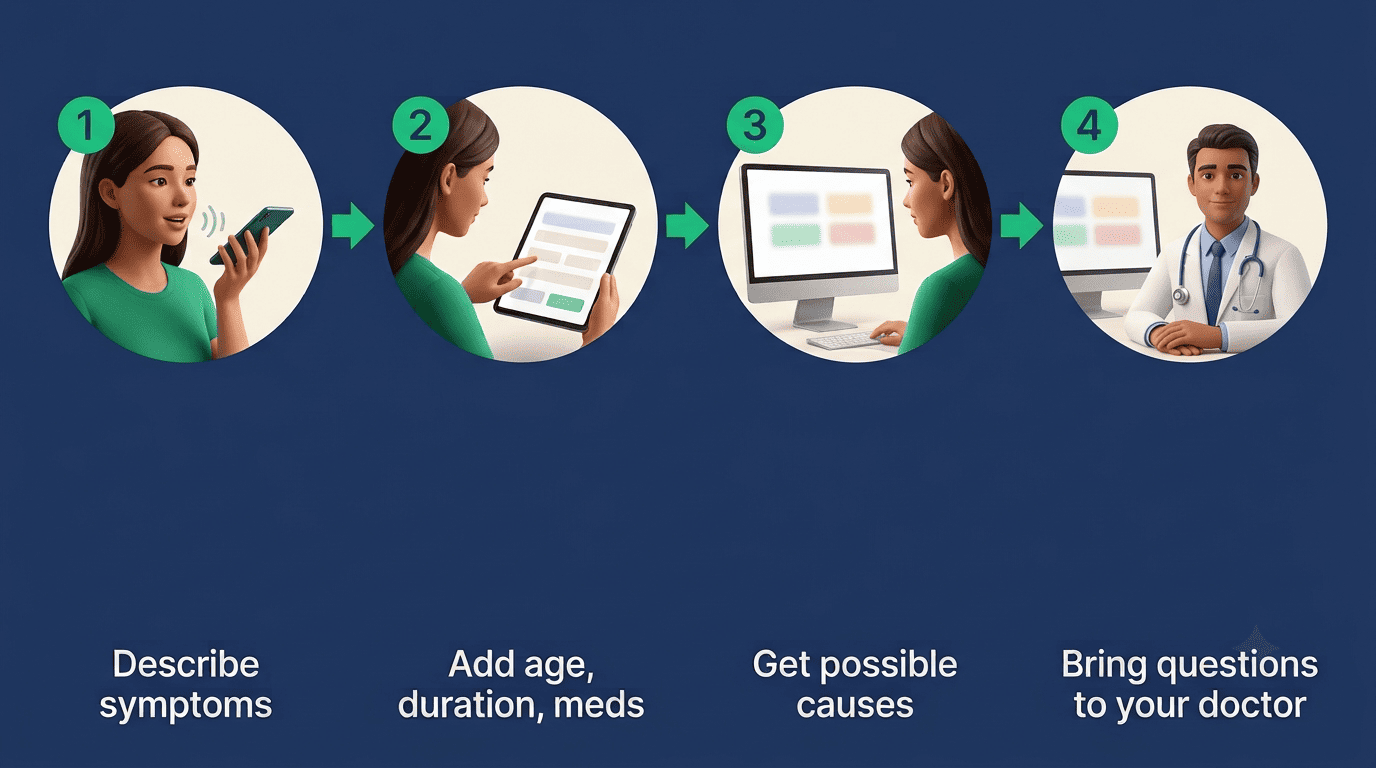
A short, structured description works better than a wall of text or a single symptom word. Before you start typing, gather the details below — most free AI doctor tools will ask for some version of them anyway.
- Your age and sex
- How long the symptom has lasted
- Where exactly it’s located
- What makes it better or worse
- Any chronic conditions you have
- Current medications and known allergies
- How severe it feels on a simple scale
Use the output as questions for your doctor
Treat the differential and any «next steps» text as a rough draft for your actual appointment, not as a conclusion. Ask the AI to explain any unfamiliar term from a lab report or discharge summary in plain language — that’s one of the things it does well. What it shouldn’t do is talk you into starting, changing, or stopping a treatment on its own; that decision stays with a licensed physician.
FAQ
A free doctor ai can explain symptoms, decode lab results, and help you prepare for an appointment — but it cannot examine you, confirm a diagnosis, or replace a licensed physician. Use it to get organized, use 911 for emergencies, use 988 for a mental-health crisis, and use a real clinician for anything in between that doesn’t resolve on its own.
This is not medical advice and not a substitute for a licensed physician’s diagnosis or treatment. In a medical emergency, call 911 (US). In a mental-health crisis, call or text 988 (Suicide & Crisis Lifeline).