
What Is an AI Symptom Checker? How It Works, How Accurate It Is, and When to See a Doctor
An AI symptom checker is a tool that takes the symptoms you describe and, using natural language processing and machine learning, returns a list of possible causes plus a suggestion on how urgently you should seek care. You can try this approach with an AI doctor to see how the intake and triage flow works in practice. It is a triage aid, not a diagnostic device — the result is a starting point for a conversation with a clinician, not an endpoint.

Independent research shows these tools can be useful for understanding symptoms, but their accuracy varies widely depending on how the disease presents, and that gap matters for how much weight you put on any single result.
This article is for general education only and is not medical advice or a substitute for a licensed physician. An AI symptom checker does not diagnose disease. If you have a medical emergency, call 911 (US). If you are in a mental-health crisis or thinking about suicide, call or text 988 (Suicide & Crisis Lifeline).
What Is an AI Symptom Checker?
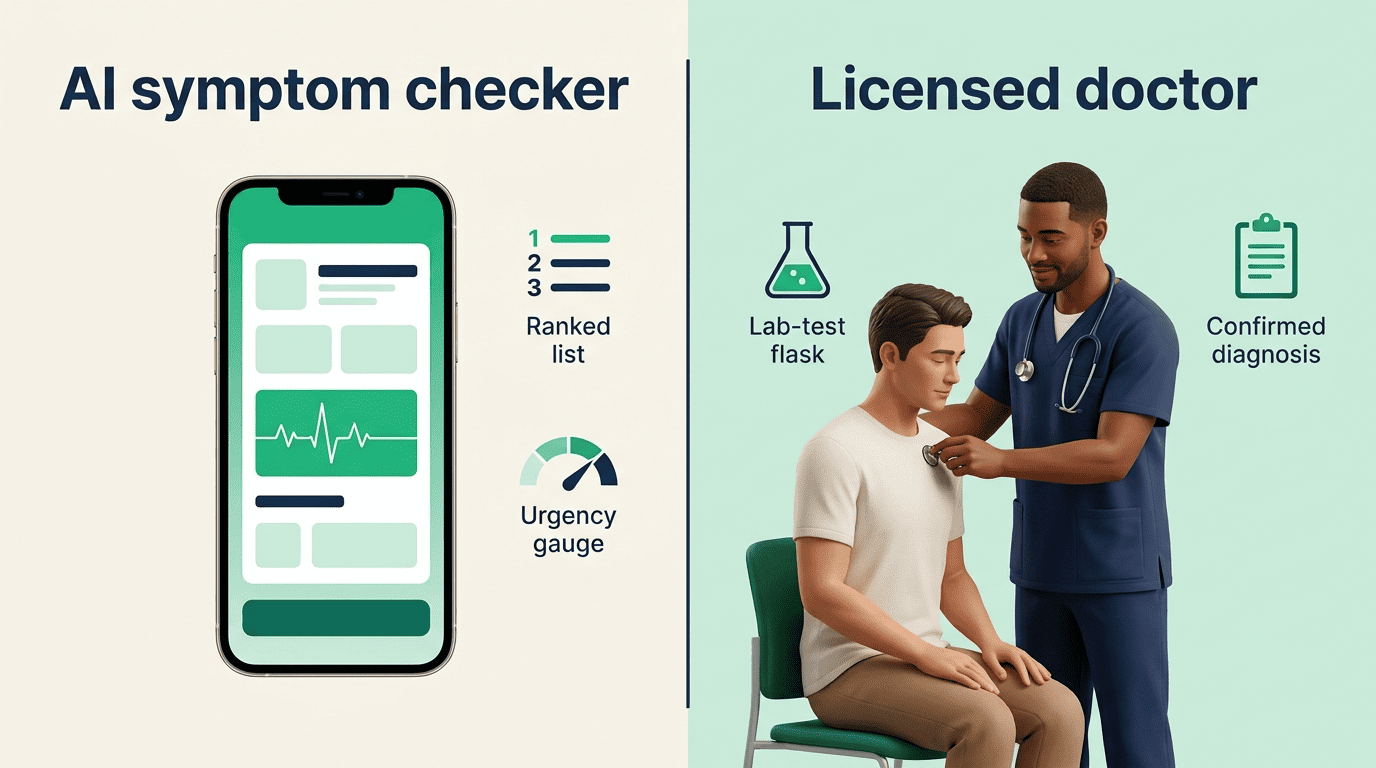
An AI-powered symptom checker is software that collects a description of what you’re experiencing — usually through a short text prompt or a set of guided questions — and returns a differential diagnosis list: a ranked set of possible explanations, not a single verdict. Alongside that list, most tools attach a triage recommendation, such as «seek emergency care,» «see a doctor within 24 hours,» or «self-care may be appropriate.» The distinction matters: an online symptom checker does not diagnose or prescribe treatment. It helps you decide how urgently, and to whom, you should turn next.
A triage aid, not a diagnosis
Think of it as a structured intake conversation rather than a verdict. The AI health assistant asks about your main complaint, then narrows things down with follow-up questions about duration, severity, and related symptoms. What comes back is a shortlist of possibilities ranked by likelihood or urgency — never a confirmed diagnosis. The leading services in this space (WebMD’s AI symptom checker, Docus, Ubie, and Doctronic) all state explicitly that their output is not medical advice and does not replace a clinician’s judgment.
Who uses them and why
A peer-reviewed JMIR survey of users of an AI-assisted symptom checker found that most people turned to the tool primarily to better understand what their symptoms might mean: 84.1% rated it useful as a diagnostic tool and 91.4% said they would use it again. That pattern lines up with a broader access problem: some healthcare-industry estimates put the share of emergency department visits that could be handled by primary or urgent care, rather than the ED, at around 30%, though other studies put the truly avoidable share much lower. Either way, it’s part of why a digital symptom checker that correctly routes people to urgent care, a primary care visit, or self-care has real practical value — when its limits are respected.
How an AI Symptom Checker Works
Under the hood, an AI symptom checker combines two layers of technology. Natural language processing (NLP) parses the free text or structured answers you provide and extracts clinically relevant features — location, duration, severity, associated symptoms. Machine learning then compares those extracted features against patterns learned from large volumes of clinical data, ranking possible causes by probability and urgency. Models used by leading tools are trained and continuously refined on clinical data drawn from hundreds of partner healthcare institutions, which is part of why accuracy can still vary depending on how closely your case resembles the training distribution.
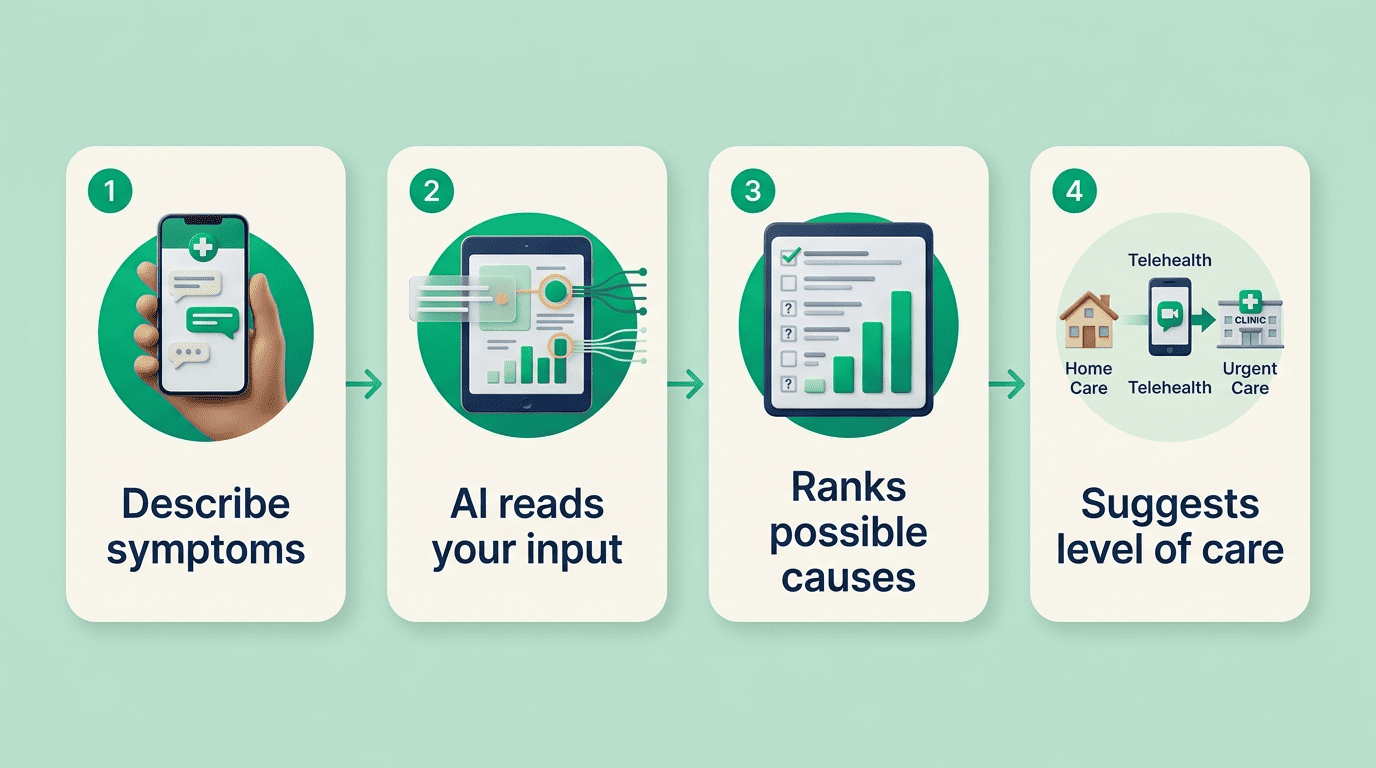
Red-flag symptoms are handled as a separate, higher-priority pathway. If your answers match patterns associated with an emergency — chest pain with shortness of breath, sudden severe headache, signs of stroke — the system is designed to short-circuit the differential-diagnosis process and immediately recommend emergency care rather than continuing the standard questionnaire.
Step by step: from symptoms to a shortlist
- You enter your main symptom, either as free text or by selecting from a guided list.
- NLP extracts clinical features from your description — what, where, how long, how severe.
- Machine learning matches those features against a knowledge base of conditions and builds a ranked differential diagnosis list.
- The tool asks a series of follow-up questions covering age, sex, medical history, and related symptoms to refine the ranking.
- You receive a shortlist of possible causes along with a triage recommendation on the appropriate level of care.
Red-flag detection and triage
The system continuously screens your answers for emergency warning signs — symptoms such as chest pain, difficulty breathing, or sudden weakness on one side of the body. The CDC publishes a reference list of emergency warning signs that most red-flag detection logic mirrors. If any of these patterns are flagged, the recommendation shifts immediately to urgent or emergency care, overriding the normal question flow.
How Accurate Are AI Symptom Checkers?
Accuracy numbers for an AI symptom checker depend heavily on how they were measured, and the gap between test conditions and real practice is large enough to change how you should use the results.
| Study type | Sample | Top-10 accuracy | Source |
|---|---|---|---|
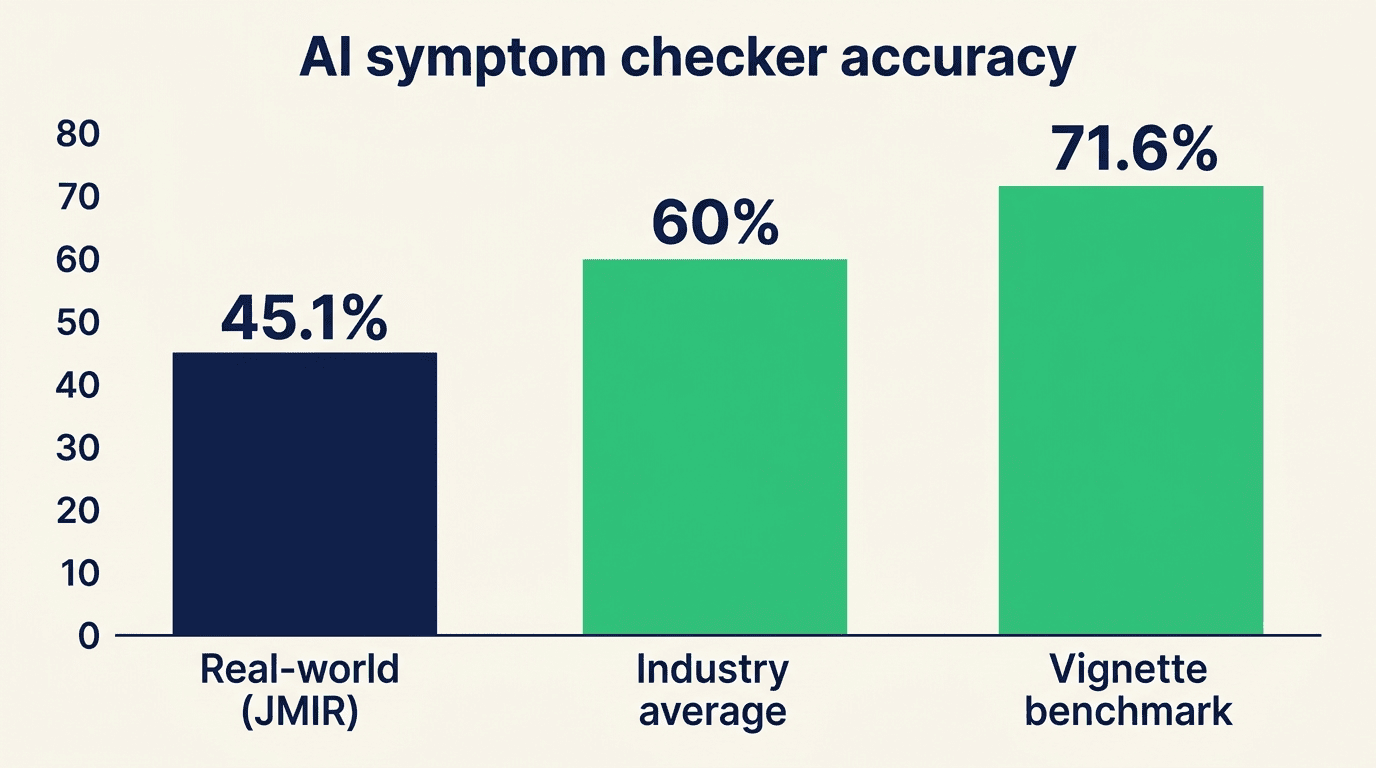
| Clinical vignette benchmark (Ubie) | 328 in-scope vignettes | 71.6% (top-5: 63.4%) | Ubie clinical vignette simulation study |
| Industry average, vignette-based | Multiple leading tools | ~60% top-10 | Ubie clinical vignette study (competitor comparison) |
| Real-world retrospective (JMIR) | 381 patients, 2019–2022 | 45.1% (172/381) | JMIR peer-reviewed accuracy study |
«The accuracy of the differential diagnosis list created by the symptom checker was low in those with uncommon diseases (30/124, 24.2%) and atypical presentations (12/83, 14.5%).»
JMIR — Diagnostic Accuracy of an AI-Based Symptom Checker (2024)
Vignette benchmarks vs the real world
Controlled vignette studies, where a symptom checker is tested against pre-written, clearly described clinical scenarios, tend to produce higher accuracy — Ubie’s benchmark reached 71.6% top-10 accuracy across 328 in-scope cases. Real-world retrospective data tells a different story: a peer-reviewed JMIR study following 381 actual patients found overall top-10 accuracy of just 45.1%. The gap exists largely because real patients describe symptoms less precisely and consistently than a scripted vignette, and they often omit details a clinician would normally ask about directly.
Where accuracy breaks down
The same JMIR study found that accuracy drops sharply for rare or atypical disease presentations. It reported an accurate differential in only 24.2% of uncommon-disease cases and 14.5% of atypical presentations, and its regression analysis showed typical presentations were far more likely to yield an accurate result than atypical ones (odds ratio 6.92), as were common diseases versus rare ones (odds ratio 4.13, both P<.001). In plain terms: the more textbook your symptoms look, the more reliable the differential diagnosis list tends to be. The more unusual or rare the underlying condition, the less you should trust a clean-looking result. A normal or reassuring output from an AI symptom checker does not rule out a serious illness — it reflects a statistical pattern match, not a clinical exam.
Are AI Symptom Checkers Safe? Can They Replace a Doctor?
No AI symptom checker, however well validated, is designed to replace a licensed physician. The output is a triage suggestion built from pattern matching, not a clinical evaluation that accounts for a physical exam, lab work, or your full medical history. Treating a differential diagnosis list as a final answer — self-treating based on it, or delaying care because a red flag wasn’t raised — is the primary safety risk with this category of tool.
Never delay emergency care because of a symptom checker result. If you are experiencing chest pain, difficulty breathing, sudden confusion, signs of stroke, or any symptom that feels like an emergency, call 911 (US) immediately rather than waiting on an app’s output.
If you are in crisis, use the crisis line, not a symptom checker. For suicidal thoughts or a mental-health crisis, call or text 988 (Suicide & Crisis Lifeline) — an AI symptom checker is not built or validated for psychiatric emergencies.
Extra caution applies to higher-risk groups. Children, pregnant patients, people with chronic or complex conditions, and anyone with psychiatric symptoms should treat AI-generated suggestions as a starting point for a conversation with a clinician, not a basis for decisions.

The FDA’s guidance on clinical decision support software draws a line between tools meant to inform a clinician’s judgment and those making autonomous diagnostic claims — most consumer-facing AI symptom checkers are built to stay on the informational side of that line, which is exactly why they carry disclaimers rather than diagnostic guarantees.
Limits you must respect
Beyond emergencies and crisis situations, be cautious relying on an AI symptom checker when symptoms are vague and long-lasting (these often need in-person evaluation rather than a quick triage pass), when you have multiple overlapping chronic conditions the tool wasn’t designed to reason about jointly, or when a prior in-person visit already raised concern about something specific — in that case, follow up with the clinician who examined you rather than restarting from an app.
Privacy and your health data
Because you’re entering sensitive health details, data handling matters. Several leading services publish specific compliance claims: Docus states it follows SOC 2, HIPAA, and GDPR standards, while Doctronic states HIPAA compliance for its symptom checker. Before using any AI health assistant, check its privacy policy for what data it retains, whether it’s shared with third parties, and how long it’s stored — and avoid entering unnecessary identifying details beyond what’s needed to get a useful triage result.
How to Use an AI Symptom Checker Well
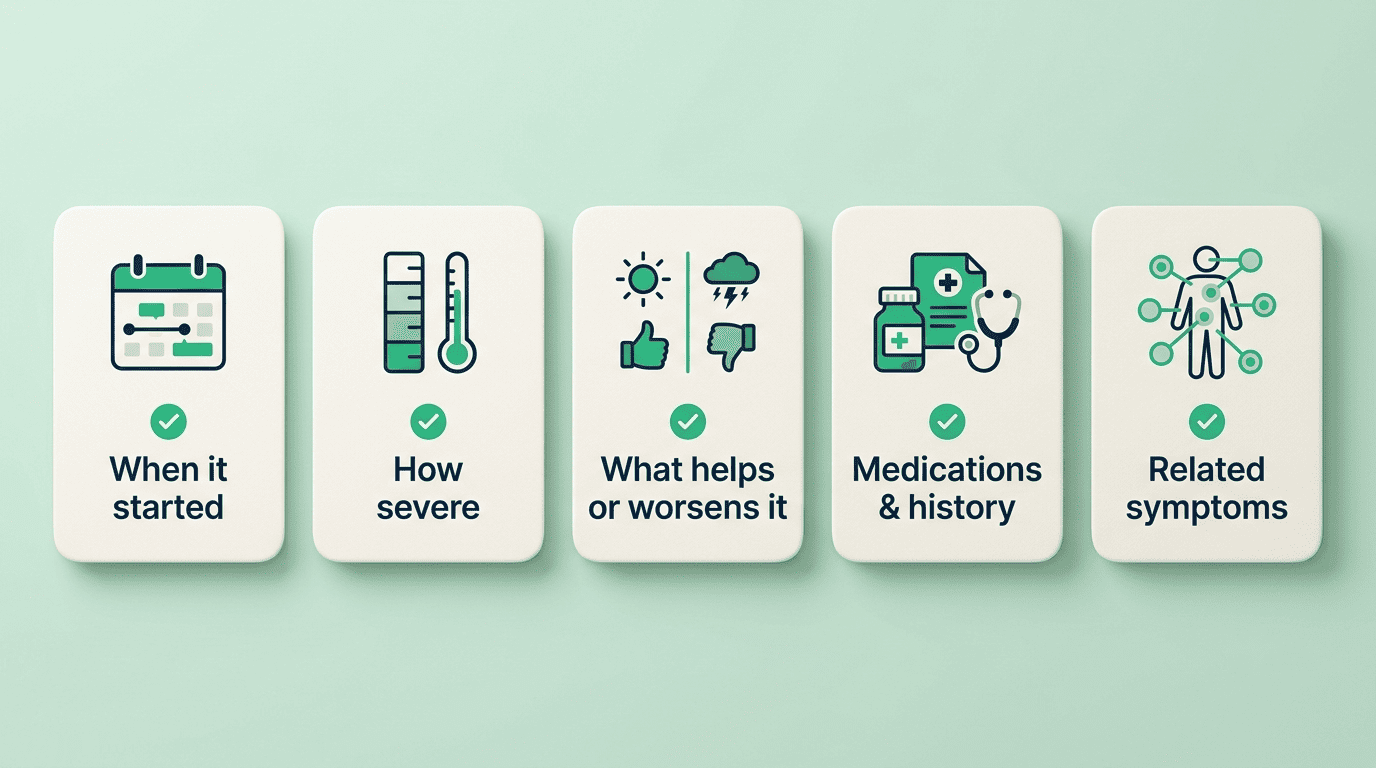
Getting a useful result from an AI-driven symptom checker depends heavily on how precisely you describe what you’re experiencing. Vague input produces a vague, less reliable differential — specific input narrows it meaningfully.
A checklist before you start
- Note when the symptom started and whether it’s constant, intermittent, or worsening.
- Rate severity honestly (mild, moderate, severe) rather than downplaying it.
- List what makes it better or worse — movement, food, rest, medication.
- Include relevant history: chronic conditions, current medications, recent travel or illness.
- Mention any symptoms that appeared alongside the main one, even if they seem unrelated.
- Be truthful about sensitive details (substance use, sexual history, mental health) — the tool can’t account for what you leave out.
Turning results into questions for your doctor
The most productive way to use a symptom checker by AI is not as a final answer but as prep material for your actual appointment. Bring the differential diagnosis list to your doctor and ask directly which possibilities they consider most likely, what tests (if any) would help narrow it down, and what warning signs should prompt you to seek care sooner. That turns a triage tool into a way to make a short appointment more efficient, rather than a substitute for the appointment itself.
How to Choose a Trustworthy AI Symptom Checker
Not all tools in this category are built or validated the same way. Before trusting one, check for a handful of concrete signals rather than taking accuracy claims at face value.
| Criterion | What to look for |
|---|---|
| Clinical validation | Published accuracy studies (vignette or real-world), ideally peer-reviewed |
| Physician involvement | Medical team or advisory board listed publicly |
| Transparency about limits | Clear statement that results are not a diagnosis |
| Data privacy | Explicit HIPAA/SOC 2/GDPR compliance claims |
| Emergency handling | Automatic red-flag detection routing to emergency care |
| Disclaimers | Visible «not medical advice» language on every result page |
A tool that is upfront about where its accuracy is weaker — rare diseases, atypical presentations — is generally more trustworthy than one that presents every result with the same confidence. The World Health Organization’s guidance on the ethics and governance of AI for health similarly emphasizes transparency about a system’s limitations as a core safeguard, not an optional disclaimer.