
Is an AI Doctor Safe? What You Should Know About Accuracy, Privacy, and HIPAA
This article is for general information only and is not medical advice. An AI doctor is not a substitute for a licensed physician and does not diagnose or treat disease. If you have a medical emergency, call 911 (US). If you are in mental-health crisis, call or text 988 (Suicide & Crisis Lifeline).
An AI doctor — an AI health chatbot that explains symptoms and health information — can be a genuinely useful tool, but whether it’s «safe» depends on how you use it and how it handles your data. An ai doctor is reasonably safe as an information aid to help you understand symptoms and prepare questions for a real appointment, and the World Health Organization agrees that AI tools in health settings need independent oversight before people should trust them with sensitive decisions.

What it is not safe for: replacing a physician, or serving as a place to dump your entire medical record without checking how that data is handled.
What an AI Doctor Actually Is (and Isn’t)
An AI health chatbot is built on a large language model, a type of AI trained to predict and generate text based on patterns in huge amounts of data. That’s a useful frame for what it can and can’t do for your health.
It’s an information tool, not a licensed clinician
An AI doctor is a large language model that answers health questions in plain language — it explains what a symptom might mean, decodes a lab term, or helps you draft questions for a real visit. It does not hold a medical license, cannot physically examine you, and cannot be held professionally or legally accountable the way a physician can. Think of it as a well-read assistant, not a diagnostician.
Where AI is genuinely strong
In narrow, well-validated tasks, AI performs close to specialist level. Image-analysis models used in radiology and dermatology can match trained clinicians on specific jobs, such as flagging suspicious skin lesions on photos or spotting patterns consistent with pneumonia on a chest scan. Even in those cases, the tools are built to assist a clinician’s judgment, not to replace it — a radiologist or dermatologist still reviews and signs off on the finding.
Symptom checkers are good at triage, not diagnosis. An AI symptom checker can point you toward «this sounds urgent, see a doctor soon» versus «this is likely minor,» but that’s guidance, not a clinical verdict.
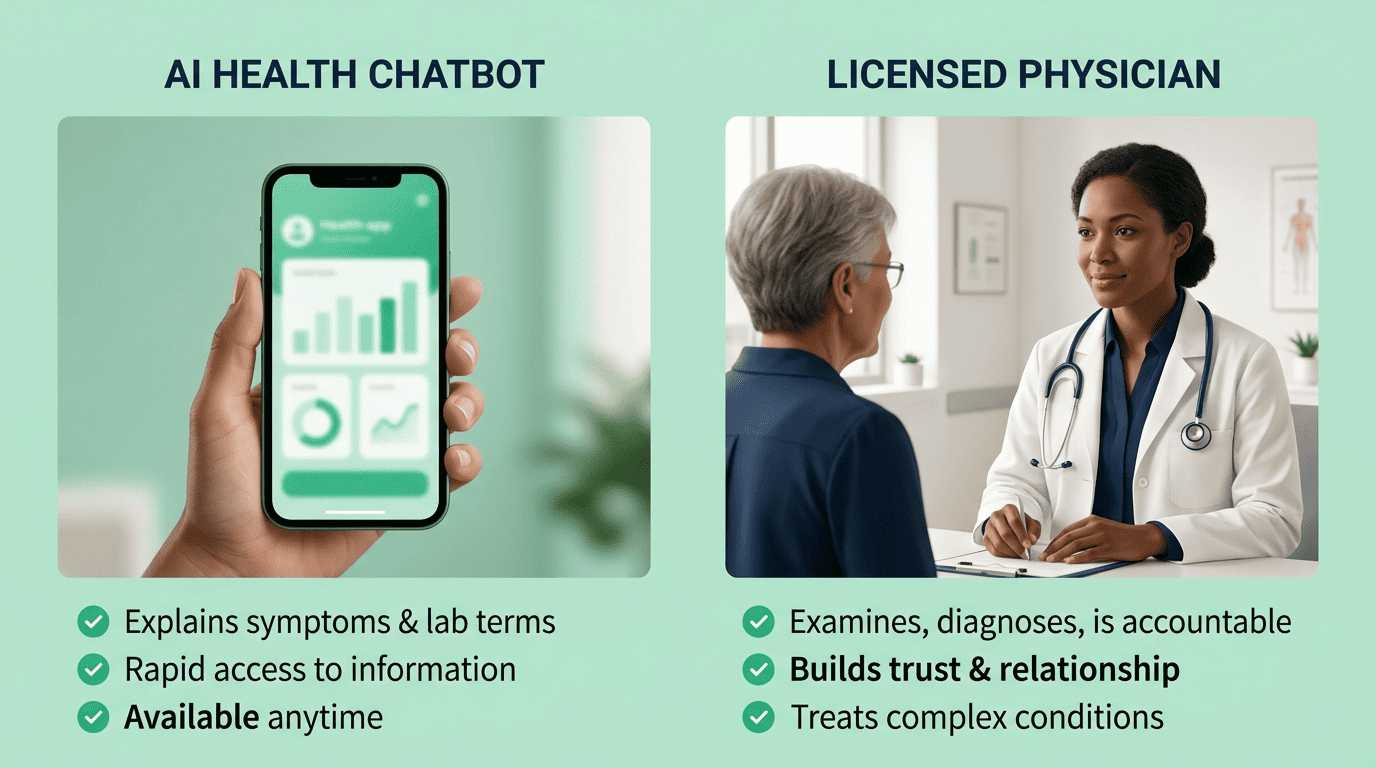
Conversational tools are good at explaining, not deciding. Ask an AI medical advisor to translate a confusing lab result into plain English, and it usually does that well. Ask it to decide your treatment, and you’ve stepped past what it’s built for.
| Task | AI health chatbot | Licensed physician |
|---|---|---|
| Explaining a symptom or lab term | Strong | Strong |
| Flagging a suspicious image (skin, scan) | Strong, in narrow validated tasks | Strong, with clinical context |
| Diagnosing a complex or atypical case | Weak, unreliable | Strong |
| Physical examination | Not possible | Yes |
| Legal/professional accountability | None | Yes |
| Prescribing or adjusting medication | Not appropriate | Yes |
Clinical Safety: Accuracy, Hallucinations, and Limits
Accuracy is the first place an AI doctor can fail you, and it’s worth understanding exactly how.
Hallucinations and missing context
AI can produce confident, plausible-sounding answers that are simply wrong — a failure mode commonly called a «hallucination.» Unlike a physician sitting across from you, a chatbot lacks your full medical history, cannot perform a physical exam, and misses the clinical nuance a trained clinician picks up from tone of voice, appearance, or a follow-up question. That gap widens sharply with complex, atypical, or multi-symptom cases, where pattern-matching on text alone isn’t enough.
The accuracy gap in sensitive areas
Sensitive conversations expose the gap most clearly. In mental-health contexts especially, researchers and clinicians have raised concerns that AI chatbot responses can miss appropriate empathy, risk assessment, or escalation that a licensed mental-health professional would provide by default. The safest approach is to treat any AI response in a sensitive area as a starting point for a conversation with a real clinician, not as the final word — especially when the topic involves mood, self-harm risk, or a rapidly changing physical symptom.
Is Your Data Private? HIPAA and AI Doctors
Privacy is the second major safety question, and it’s more complicated than most people assume.
What HIPAA does — and who it covers
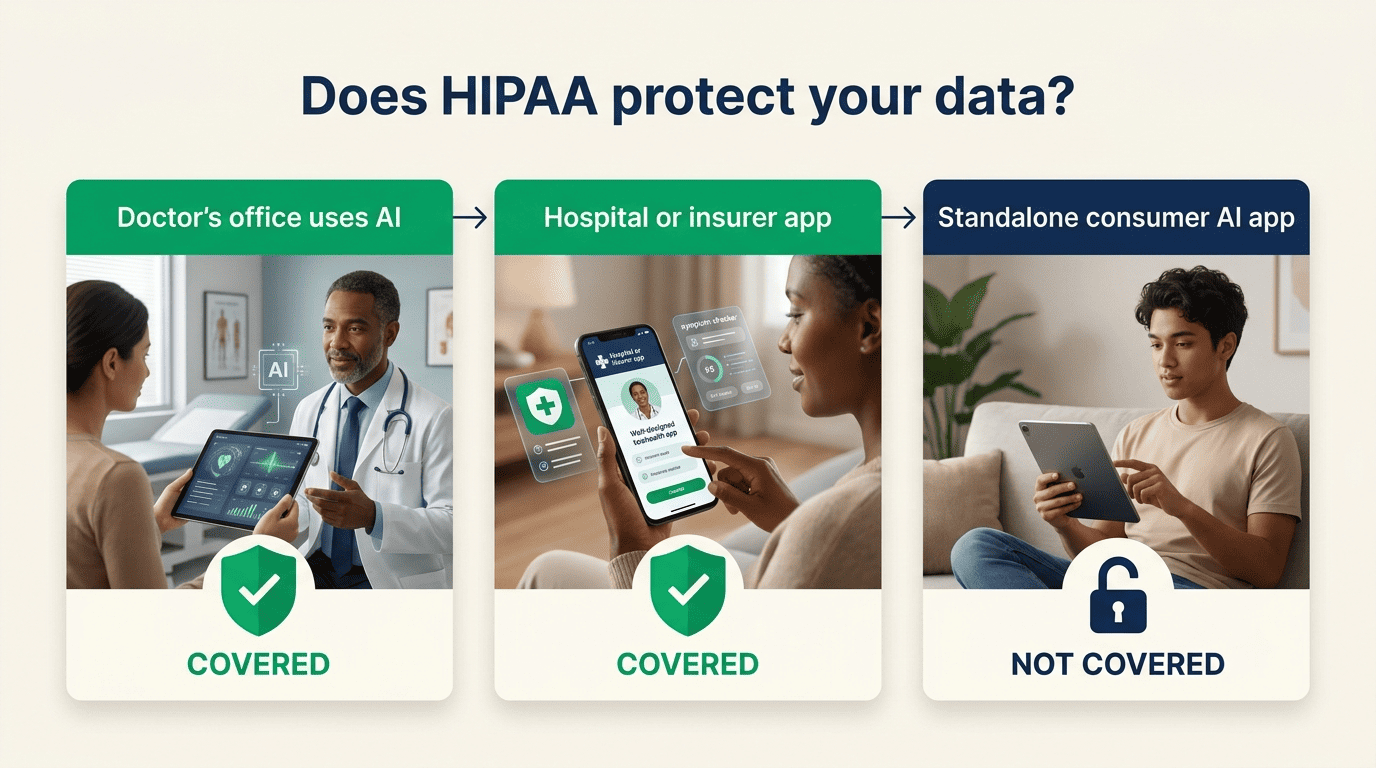
HIPAA, the Health Insurance Portability and Accountability Act, protects «protected health information» that is held by covered entities — health care providers, health plans, and health care clearinghouses — along with their business associates. If your own doctor’s office uses an AI tool inside its practice to help with your care, that use is generally bound by the provider’s existing HIPAA obligations, because the provider itself is the covered entity. You can read the government’s own explanation of these protections at HHS.gov.
| Situation | Is HIPAA likely to apply? |
|---|---|
| Your doctor’s office uses an AI tool inside the practice | Usually yes — the provider is the covered entity |
| A hospital or insurer offers a branded AI chat tool | Usually yes — tied to a covered entity or business associate |
| You open a general consumer AI health app on your own | Usually no — governed by its own privacy policy, not HIPAA |
| A wellness or symptom-checker app with no clinical partner | Usually no — treated as a consumer product |
Why many consumer AI chat tools are NOT HIPAA-covered
A general-purpose AI health chatbot you open on your phone and use directly is usually not itself a HIPAA covered entity. It’s typically treated as a consumer «wellness» product governed by its own privacy policy, plus general consumer-protection rules enforced by the Federal Trade Commission and applicable state law — not by HIPAA. This is a critical, widely misunderstood point: whether HIPAA applies depends entirely on who is deploying the tool, not on how «medical» the app sounds. Marketing language like «HIPAA-ready» or «supports HIPAA compliance» describes a technical capability, not a legal guarantee that your conversation is protected the same way your doctor’s records are.
The Real Privacy Risks
Beyond the HIPAA technicality, there are concrete risks worth understanding before you type in a symptom.
Re-identification and data selling
«Anonymous» health data is often not as anonymous as it sounds. De-identified information can frequently be re-identified when it’s cross-referenced with other datasets — location history, purchase records, or public records can be enough to narrow an «anonymous» entry back down to one person. If an app isn’t a HIPAA covered entity, it may be legally free to retain, share, or sell the data you voluntarily type in, subject only to whatever its own privacy policy allows. That makes reading the privacy policy before your first real conversation genuinely worthwhile, not a formality. The Federal Trade Commission, which polices consumer data practices outside HIPAA, has been direct about how it treats overstated AI claims:
False or unsubstantiated claims about a product’s efficacy are our bread and butter.
Federal Trade Commission — Keep your AI claims in check
Bias and safety-technology mitigations
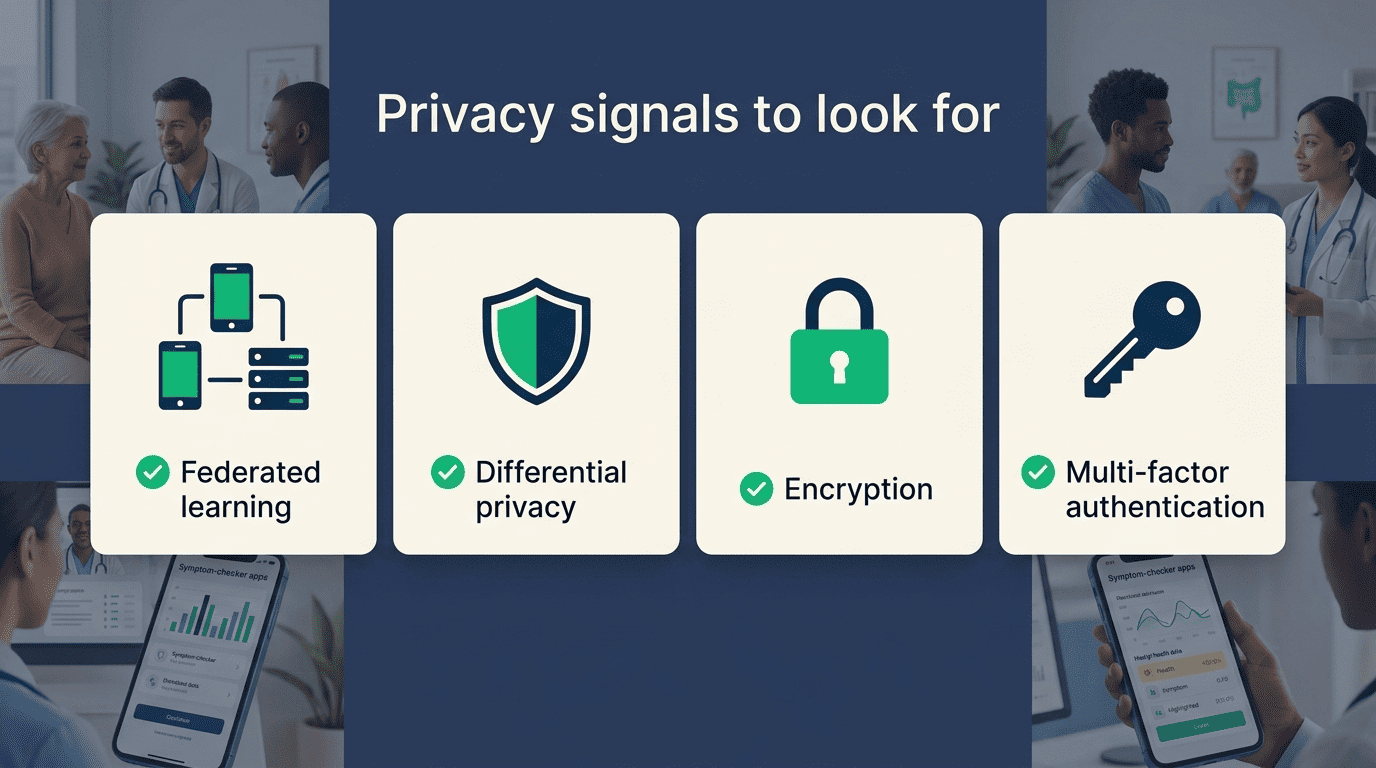
Algorithmic bias is a related, quieter risk: a model trained mostly on data from one demographic group can perform less reliably for people outside that group, which matters when the output touches something as personal as your health. Better-designed health platforms address these risks with privacy-preserving engineering. Signals worth checking for before you trust a platform with health data include:
- Federated learning — the model trains without your raw data leaving your device
- Differential privacy — statistical noise is added so individuals can’t be singled out
- Encryption in transit and at rest
- Multi-factor authentication (MFA) on your account
No single feature makes a tool automatically trustworthy, but their presence is a reasonable signal that a platform takes data protection seriously.
When to Trust AI — and When to Call a Real Doctor
This is the part of the article worth bookmarking.
Emergencies: never use AI
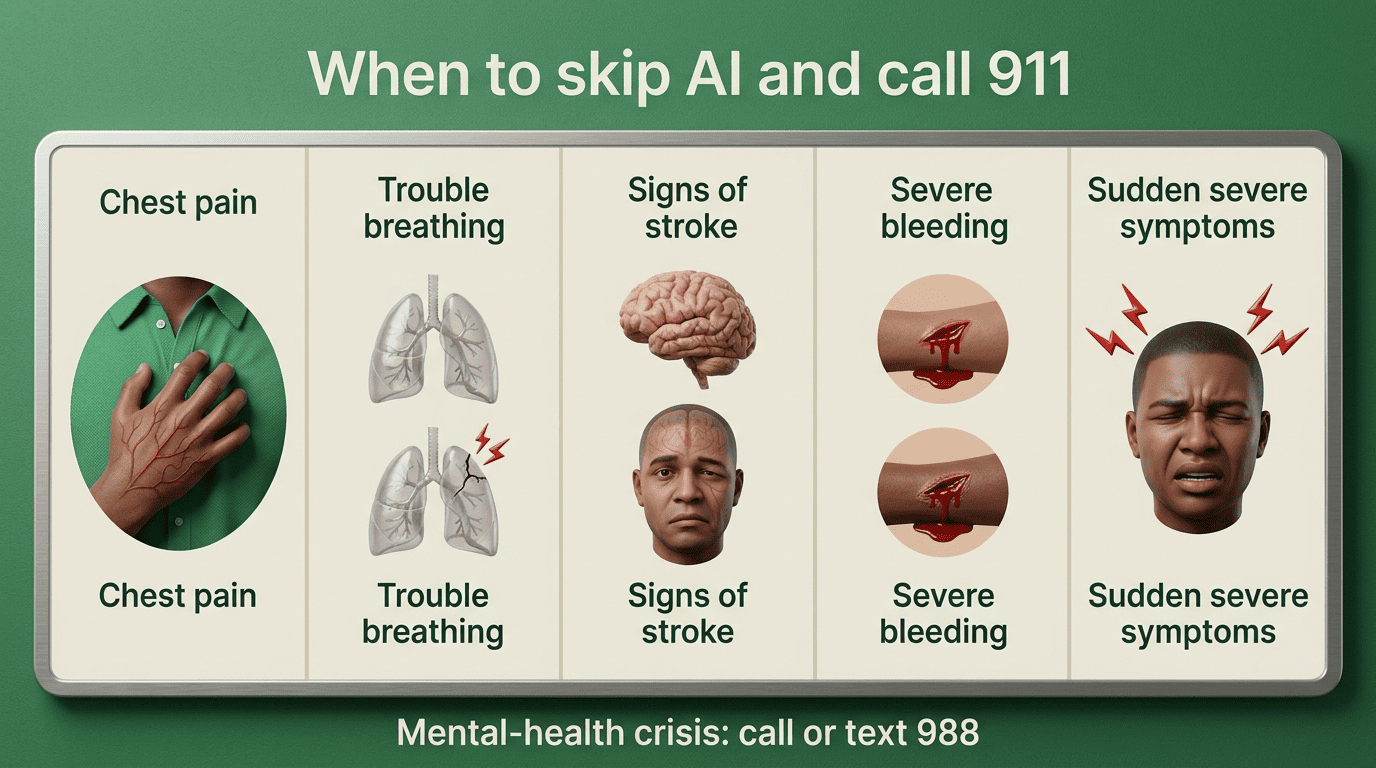
Skip the chatbot and call 911 (US) immediately if you notice any of the following:
- Chest pain or pressure
- Trouble breathing
- Sudden numbness, confusion, or other signs of stroke
- Severe or uncontrolled bleeding
- Any sudden, severe, or rapidly worsening symptom
If you or someone you know is having thoughts of self-harm or is in a mental-health crisis, call or text 988, the Suicide & Crisis Lifeline, right away. These two numbers matter more than anything else in this article.
Good uses vs. decisions
Good use of an AI doctor looks like:
- Understanding an unfamiliar medical term or lab result
- Learning the general shape of a condition
- Drafting a clear list of questions before your appointment
What an AI doctor should never be used for: diagnosing yourself, changing or stopping a medication, or making a treatment decision on your own. Those calls belong to a licensed clinician who knows your history.
How to Use an AI Doctor Safely
If you understand the limits above, an AI health chatbot can still be a genuinely useful part of managing your health — as long as you follow a few concrete habits.
A practical safety checklist
- Check who’s behind the app. If it’s tied to a hospital, clinic, or insurer, it’s more likely operating under HIPAA obligations than a standalone consumer app.
- Read the privacy policy before you rely on it. Look specifically for language about whether your data is sold or shared with advertisers.
- Share only what you need to. Avoid uploading your full medical record, your Social Security number, or other identifiers the tool doesn’t actually need to answer your question.
- Turn on multi-factor authentication if the app offers it — it’s a small step that meaningfully reduces the risk of someone else accessing your health conversations.
- Treat every answer as a first step, not a final one. Use it to get informed, then verify anything important with a licensed clinician.
- Keep your real doctor in the loop. Mention what you asked an AI doctor at your next visit — it helps your physician understand what you’re worried about and correct anything inaccurate.
Following this checklist is a core part of ai doctor safety: the technology itself is only half the equation — how carefully you use it is the other half.