
AI Doctor vs Real Doctor: What Each Can (and Can’t) Do for You
This article is for general information only and is not medical advice. An AI doctor is not a substitute for a licensed physician and does not diagnose or treat disease. If you have a medical emergency, call 911 (US). If you are in mental-health crisis, call or text 988, the Suicide & Crisis Lifeline.
An ai doctor can answer health questions any hour of the day, but it is a guide, not a replacement for a licensed physician. The honest answer to «AI doctor vs real doctor» is that they do different jobs: AI helps you understand and prepare, while a real doctor examines, diagnoses, and treats. This article compares what each one can and can’t do, what the actual studies found, and exactly when you need to stop typing symptoms into a chatbot and call for help.
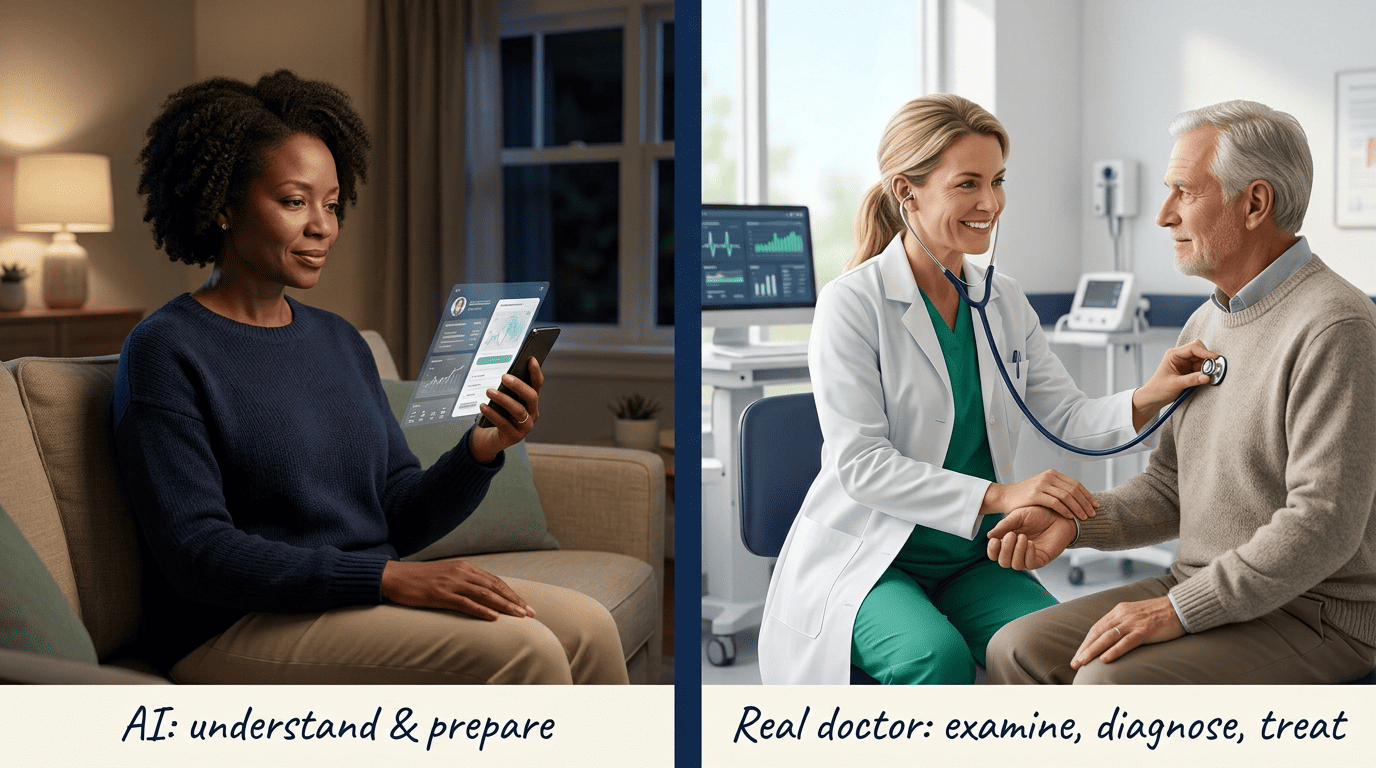
Can an AI Doctor Replace a Real Doctor? (Short Answer: No)
Even where an AI physician beats human doctors on a narrow test, no serious researcher or medical body argues it should replace them. The consensus across the studies below is consistent: AI is a support tool, and the licensed physician stays in the loop as the final decision-maker.
The consensus: complement, not replacement
In a 2026 study published in Science, researchers from Harvard Medical School and Beth Israel Deaconess Medical Center tested a reasoning AI model against experienced internal-medicine physicians on real electronic health record cases — and the model outperformed the doctors on diagnostic accuracy. Even so, the authors were explicit about what the result means and doesn’t mean:
We know that doctors getting second opinions from their human colleagues generally improves care.
Dr. Adam Rodman, study co-author, quoted in Harvard Magazine
That framing lines up with how the American Medical Association describes the technology: not «artificial intelligence» replacing clinicians, but «augmented intelligence» — a tool that extends what a physician can do rather than substituting for their judgment, license, and accountability.
Why «who wins» is the wrong question
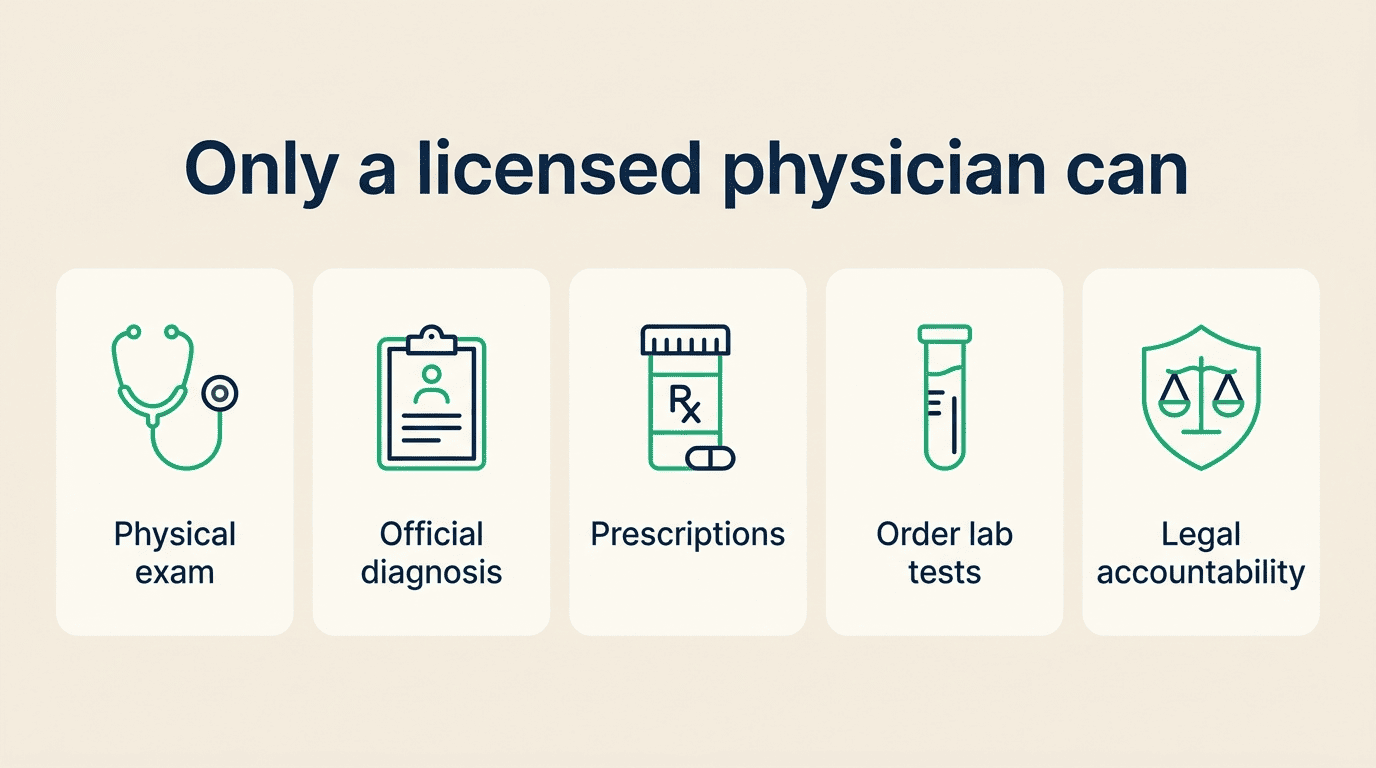
AI physician and human doctor are solving different problems. A benchmark score tells you how well a model matches patterns in a fixed set of test questions; it says nothing about physically examining a patient, ordering the right follow-up test, or being legally responsible if something goes wrong. By law, only a licensed physician can:
- Perform a hands-on physical examination
- Issue an official diagnosis
- Write or adjust a prescription
- Order labs or imaging and interpret them in clinical context
- Be held professionally and legally accountable for the outcome
That gap in trust shows up in patient behavior too — most people who use an AI symptom checker or medical AI tool still want a real clinician to confirm anything that matters before they act on it.
AI Doctor vs Real Doctor: Side-by-Side Comparison
The table below is the honest version of the comparison — not «AI vs doctor, who’s smarter,» but what each one is actually built to do.
What each one does
| What you need | AI doctor | Real doctor |
|---|---|---|
| Availability | 24/7, instant | Limited by appointments |
| Typical cost | ~$20–50/month or free | ~$200–400 per visit (uninsured) |
| Physical exam | Not possible | Yes |
| Official diagnosis | No | Yes |
| Prescriptions | No | Yes |
| Ordering labs/imaging | No | Yes |
| Explaining results & terms | Strong | Strong, but time-limited |
| Emotional support/empathy | Can simulate, inconsistent | Trained, in-person |
| Legal accountability | None | Yes |
| Handling emergencies | No — refer out | Yes |
| Continuity of care over time | Limited, no ongoing exam | Yes |
The bottom line of the table
An AI health assistant wins on access, explanation, and low-cost triage support — it’s available at 2 a.m., never rushes you, and can decode a lab report as many times as you ask. A real doctor wins on everything that requires a body in the room: an exam, a diagnosis, a prescription, and someone who is professionally and legally accountable for the outcome. The overlap between the two columns is small on purpose — they’re built to complement each other, not compete.
How Accurate Is AI at Diagnosis, Really?
The headline numbers on AI diagnostic accuracy look impressive, but the details matter more than the score. Three studies, in particular, get cited constantly — here’s what each one actually found:
| Study | AI score | Physician score | What it actually measured |
|---|---|---|---|
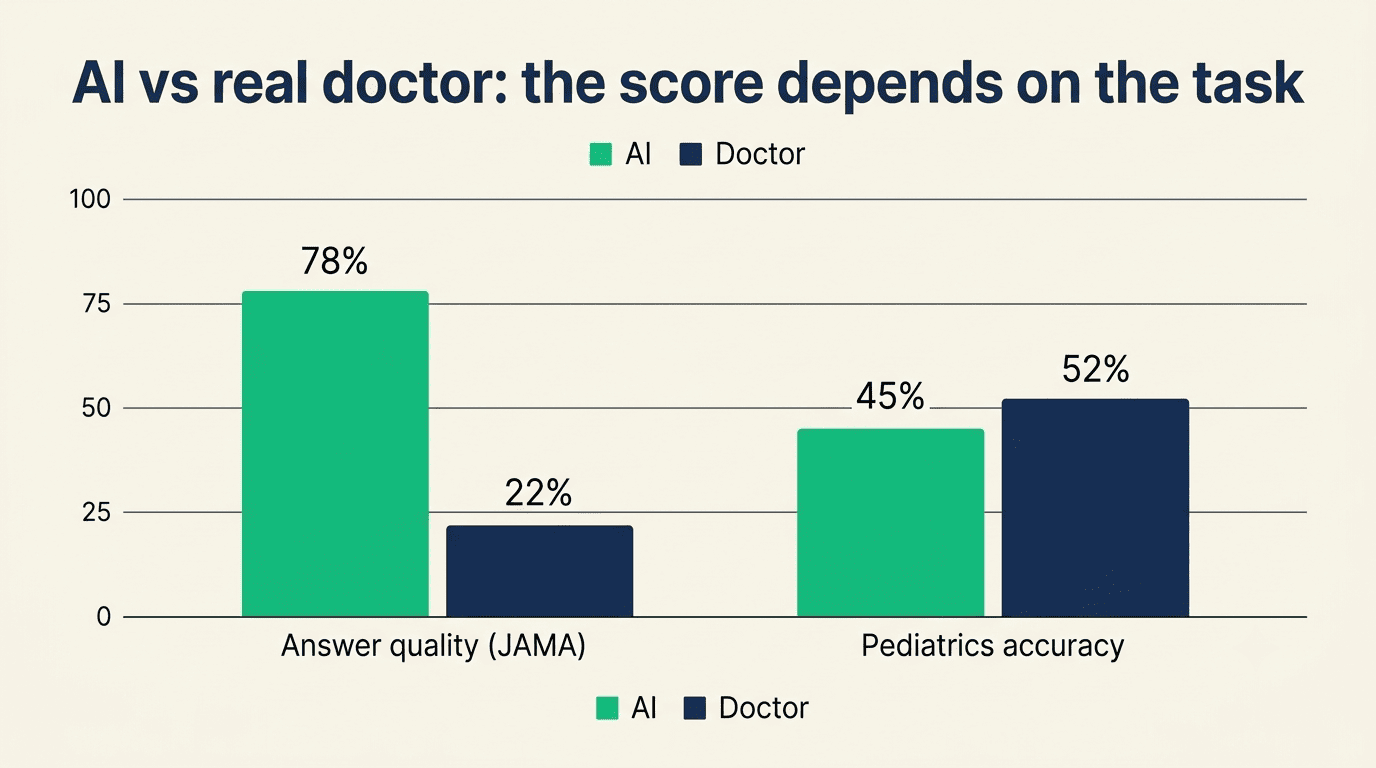
| JAMA Internal Medicine (Ayers et al.) | 78% «good/very good» quality | 22% | Perceived quality and empathy, not factual accuracy |
| PMC cross-sectional study, 17,144 physicians | 72–96% | 46–62% | General medical-knowledge exam questions |
| Same study, pediatrics domain only | 45% | 52% | Pediatric medical-knowledge questions — AI trailed here |
A JAMA Internal Medicine study set the tone for this debate. Researchers led by Ayers and colleagues had a chatbot answer 195 real patient questions pulled from a public forum, then had licensed physicians blindly rate both the AI and human-written responses. The AI’s answers were rated «good» or «very good» quality 78% of the time, versus 22% for physician answers, and rated «empathetic» or «very empathetic» 45% of the time versus just 4.6% for physicians.
A separate, larger peer-reviewed study spanning 17,144 physicians and 221,574 responses found GPT-4-turbo scoring 72–96% on general medical-knowledge benchmarks, compared with 46–62% for the human physicians in the same study, according to research indexed on PMC.
The caveat the headlines skip
Here’s what most coverage of that JAMA study leaves out, and it matters for anyone deciding how much to trust an AI physician: the study never measured factual accuracy or fabricated information — only tone, completeness, and perceived empathy. The AI’s answers were also about four times longer on average (211 words versus 52), which researchers note could inflate ratings of «thoroughness» independent of whether the answer was actually correct. As Dr. Robert Shmerling put it when reviewing this research for Harvard Health Publishing:
It seems premature to rely on AI answers to patient questions without solid proof of their accuracy and actual supervision by healthcare professionals.
Dr. Robert Shmerling, Harvard Health Publishing
A benchmark score is not the same thing as safety at the bedside. That distinction is the single most important thing to understand before trusting any AI symptom checker with a real decision.
Where AI Is Strong — and Where It’s Dangerous
Knowing the boundary between these two zones is the difference between using an AI doctor well and using it badly.
Explaining a symptom in plain language. Ask what a term on your lab report means, or what a symptom could plausibly indicate, and a medical AI tool will typically walk you through it clearly and patiently, without rushing.
Estimating urgency before you decide whether to go in. A well-designed AI symptom checker can help you gauge «this needs same-day care» versus «this can probably wait,» which is a genuinely useful triage function even though it isn’t a diagnosis.
Supporting — not replacing — a specialist’s screening. In the Swedish MASAI trial, AI-assisted mammography review increased cancer detection by 29% while cutting radiologists’ screen-reading workload by about 44% — a real gain, but one built around a radiologist still confirming the finding, not an AI acting alone.
Preparing for an appointment. Drafting the questions you want to ask, in the ten minutes before your doctor walks in, is one of the highest-value, lowest-risk uses of an AI health assistant.
Now the red zone, where an AI doctor can genuinely hurt you if you rely on it alone:
- Hallucinations — AI can confidently generate facts that are simply false, with no built-in signal that it’s guessing
- Pediatrics — real doctors were more accurate than the AI in one comparison (52% versus 45%)
- Pediatric case misdiagnosis — in a separate audit published in JAMA Pediatrics, ChatGPT-3.5 gave an incorrect or too-broad diagnosis in 83% of 100 real pediatric case challenges
- Incomplete information — one comparison study found ChatGPT’s diagnostic accuracy falling from 93.3% with a full clinical picture down to 76.6% using medical history alone
- Complex or fast-changing presentations — exactly where an AI physician’s pattern-matching breaks down, and exactly where a real doctor’s judgment matters most
How to Use an AI Doctor Safely (Alongside Your Real One)
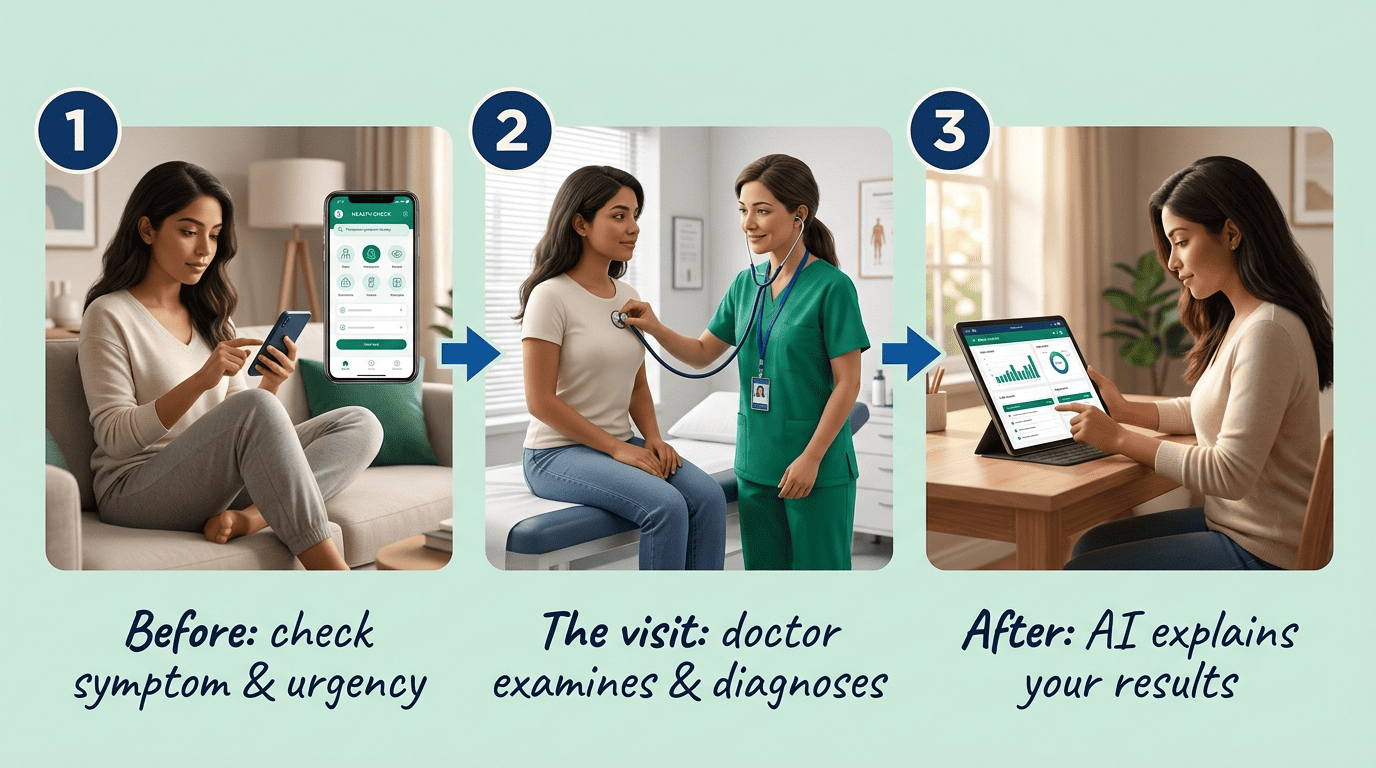
The safest way to use an AI doctor is as a tool you pick up before and after a real visit, never instead of one.
A safe workflow
- Before symptoms escalate, ask the AI to help you understand what’s going on and how urgent it feels.
- Use that answer to decide whether to book an appointment, go to urgent care, or call 911 — never to talk yourself out of care you’d otherwise seek.
- Write down 3–5 questions the AI helped you clarify, and bring them to the visit.
- After the visit, use the AI doctor to decode your after-visit summary, unfamiliar terms, or a new prescription’s instructions.
- Flag anything that still feels unclear or worrying to your real doctor at the next contact, rather than resolving it with another AI query.
- Never enter information you wouldn’t want stored or shared — treat a consumer AI health chatbot like any other app collecting personal data.
Questions to bring to your real doctor
- What does this symptom mean specifically in my medical history and context?
- Do I need any tests or imaging to confirm this?
- What are my treatment options, and what are the risks of each?
- What would make you want to see me again sooner?
An AI medical assistant is good at helping you phrase these questions well. Only your physician can actually answer them.
When You Must See a Real Doctor — or Call for Help
No AI symptom checker, however accurate its benchmark score, is built to handle an emergency. This is the section worth remembering even if you skip the rest.

Emergency warning signs — call 911
Call 911 immediately, and skip any AI tool entirely, if you or someone near you has:
- Chest pain or pressure
- Trouble breathing or shortness of breath
- Sudden numbness, confusion, slurred speech, or drooping on one side of the face (signs of stroke — think FAST: Face, Arms, Speech, Time)
- Severe or uncontrolled bleeding
- Loss of consciousness
- Signs of a severe allergic reaction (swelling of the face/throat, difficulty breathing)
According to guidance from major U.S. health authorities, any of these signs calls for emergency services, not a chat window — the minutes lost typing symptoms into an app can matter.
Mental-health crisis — call or text 988
If you or someone you know is having thoughts of self-harm or suicide, call or text 988, the Suicide & Crisis Lifeline, available 24/7 in the United States. An AI doctor is not a crisis service and should never be the last stop when someone is in danger.