
Ask an AI Doctor About a Medication: What It Can (and Can’t) Tell You
An ai doctor can be a fast, judgment-free first stop when you want to understand a medication — what it treats, its common side effects, and what to double-check with a professional. According to MedlinePlus, the National Institutes of Health’s consumer drug-information service, patients who understand their prescriptions are more likely to take them correctly.

But there’s a firm line: an AI can explain and help you prepare questions — it cannot prescribe, change your dose, or replace your pharmacist or physician.
Medical disclaimer: This article is for general information only and is not medical advice or a substitute for a licensed physician or pharmacist. Never start, stop, or change a medication based on AI. In a medical emergency call 911 (US). For a suspected poisoning or overdose, call Poison Control at 1-800-222-1222. For a mental-health crisis, call or text 988.
What an AI Doctor Can Actually Tell You About a Medication
A medical AI chatbot works by pulling from peer-reviewed literature, official drug labels, and structured medical databases, then translating that material into plain language. It won’t diagnose you or write a prescription, but it can walk you through the basics of a drug fast, any time of day, which is exactly why so many people now type questions like «What are the side effects of amoxicillin?» into a chat window before ever picking up the phone.
Plain-language explanations of what a drug is for
An AI medical assistant can translate the clinical purpose of a drug into everyday language — for example, that a statin lowers cholesterol to reduce heart-disease risk, or that amoxicillin is an antibiotic used against bacterial infections rather than viruses. Reputable tools build these explanations on peer-reviewed literature and the same official label data the FDA requires manufacturers to publish. For the authoritative version of that same information, written for consumers, MedlinePlus — run by the National Library of Medicine — remains the reference point to cross-check anything an AI doctor tells you.
How to phrase a good question
Vague prompts get vague answers. Instead of asking a medical chat assistant something broad, be specific: «What is metformin used for?», «What are the common side effects of amoxicillin?», or «What should I avoid while taking this medication?» The more detail you supply — drug name, dose, other medications you’re on — the more organized and useful the response will be to bring into your next appointment.
Understanding Side Effects With AI — and Where to Verify
Side effects fall into two very different buckets, and an AI medication assistant can help you sort a headache from a hospital visit — but it can’t tell you which bucket applies to you without knowing your full medical history.
Common vs. serious side effects
An AI doctor can separate expected, usually mild effects from warning signs that call for urgent care. Always cross-check whatever it tells you against the official FDA-approved label on DailyMed, the government’s repository of drug labeling maintained by the National Library of Medicine. Severity and likelihood also depend heavily on your own history, which brings up the next point.
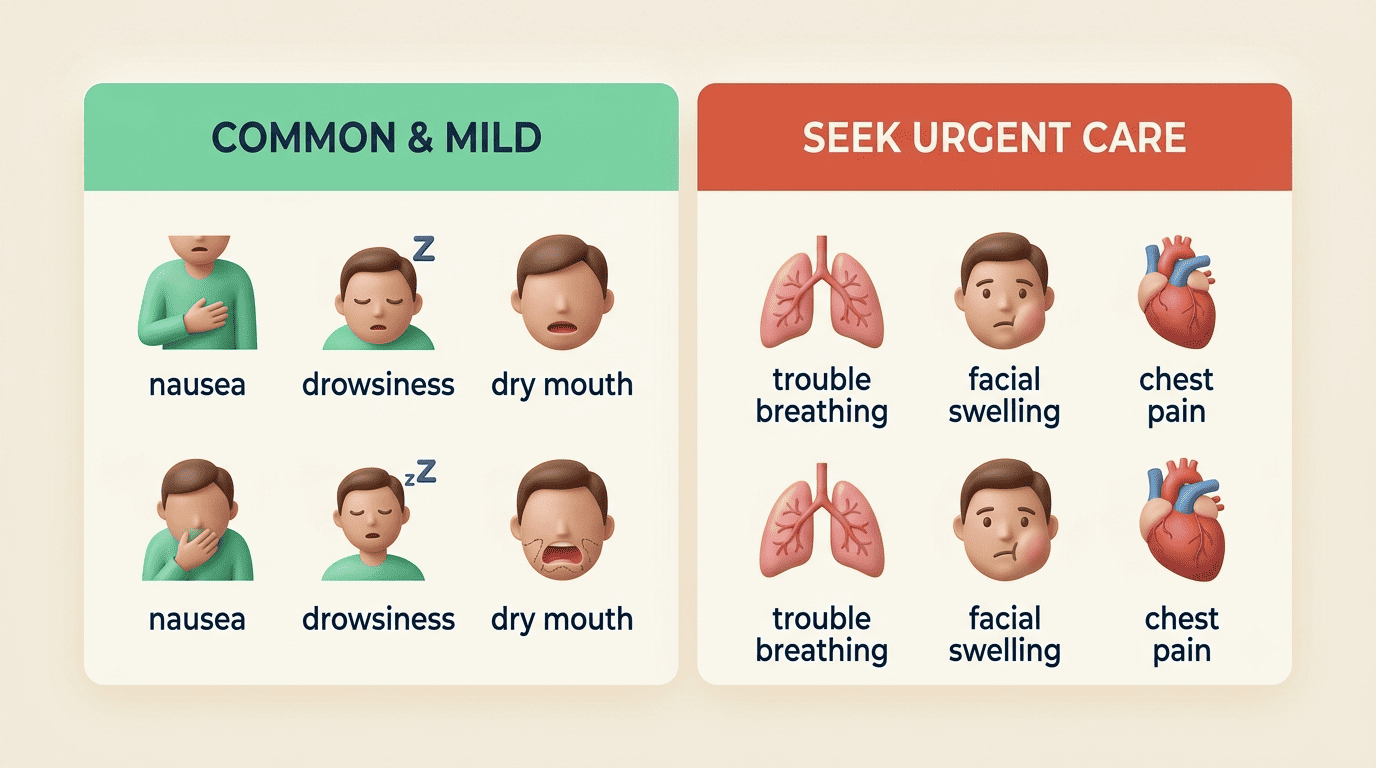
Typical examples an AI doctor might point out:
- Common and usually mild: nausea, drowsiness, dry mouth, mild headache
- Worth a call to your pharmacist: rash, persistent dizziness, unusual fatigue
- Seek urgent care now: difficulty breathing, swelling of the face or throat, chest pain, fainting
What AI does NOT know about your side-effect risk
Your kidney and liver function, allergies, pregnancy status, and full medication list all shape your real risk profile — and an AI medical assistant typically doesn’t have full access to any of it. It can offer general information about a drug population-wide, not a personal risk assessment. That distinction is precisely the job of a physician or pharmacist, who can see your chart.

Here’s a quick side-by-side of what each source is actually good for:
| Question | AI doctor | Pharmacist / physician |
|---|---|---|
| What does this drug generally do? | Yes — plain-language summary | Yes, plus your specific case |
| What are the common side effects? | Yes — general list | Yes, tailored to your history |
| Is this side effect dangerous for ME? | No — lacks your chart | Yes |
| Can I stop taking it? | No — never advise this | Yes, with medical judgment |
| Will it interact with my other 3 prescriptions? | Partial — flags known pairs | Yes — full reconciliation |
Checking Drug Interactions: A Powerful but Incomplete Signal
Why interactions matter so much
Two drugs that are perfectly safe alone can amplify or blunt each other’s effect when combined — and the scale of the problem is bigger than most people assume. Research cited by the FDA has found drug-drug interactions behind roughly a third of preventable adverse drug reactions, and roughly 1 in 5 U.S. adults aged 40 to 79 take five or more prescription medications at once — a pattern known as polypharmacy that multiplies the odds of a missed interaction, with the share climbing even higher among older adults. Interactions aren’t limited to prescriptions, either. Categories worth mentioning to an AI doctor or your pharmacist include:
- Over-the-counter painkillers and cold medicines
- Vitamins and herbal supplements (St. John’s Wort, fish oil, and others)
- Alcohol
- Grapefruit and grapefruit juice, which affect several common drug classes
- Antacids and calcium or iron supplements
As the FDA puts it plainly:
Drug interactions may cause you to experience an unexpected side effect… It’s important for you to keep track of all the medicines you use, and to talk to your health care professional about possible drug interactions.
U.S. Food and Drug Administration
What research-grade AI can do (and why your chatbot isn’t that)
It’s worth distinguishing consumer-facing AI doctors from the research-grade models built specifically to hunt for interactions. A 2023 Microsoft Research model called DSN-DDI predicted drug-drug interactions with over 99% accuracy in controlled testing on existing drugs. Penn State researchers built an alert system in 2019 trained on about 1.7 million FDA serious-outcome reports, aimed at flagging life-threatening combinations without triggering constant false alarms. Vanderbilt researchers followed in 2024 with an NLP model that surfaced interactions missing from the widely used DrugBank database. These are specialized research tools trained directly on FDA adverse-event data — not the general-purpose chatbot you’re chatting with at midnight, which may simply not know about a rarer combination. That gap is exactly why a pharmacist’s review still matters.
The Hard Line: What an AI Doctor Will Not Do
AI doctors do not prescribe or adjust doses — full stop. Only a state-licensed clinician can legally write or change a prescription. Reputable AI-doctor platforms use what’s called a «human-in-the-loop» model: the AI gathers your information and drafts a summary, but a licensed physician reviews it and makes the actual medical decision. Federal rules go further for higher-risk drugs — the Ryan Haight Act generally requires an in-person medical evaluation before a provider can prescribe a controlled substance through telehealth (subject to periodically renewed temporary exceptions), closing the loophole an AI-only service could otherwise exploit.
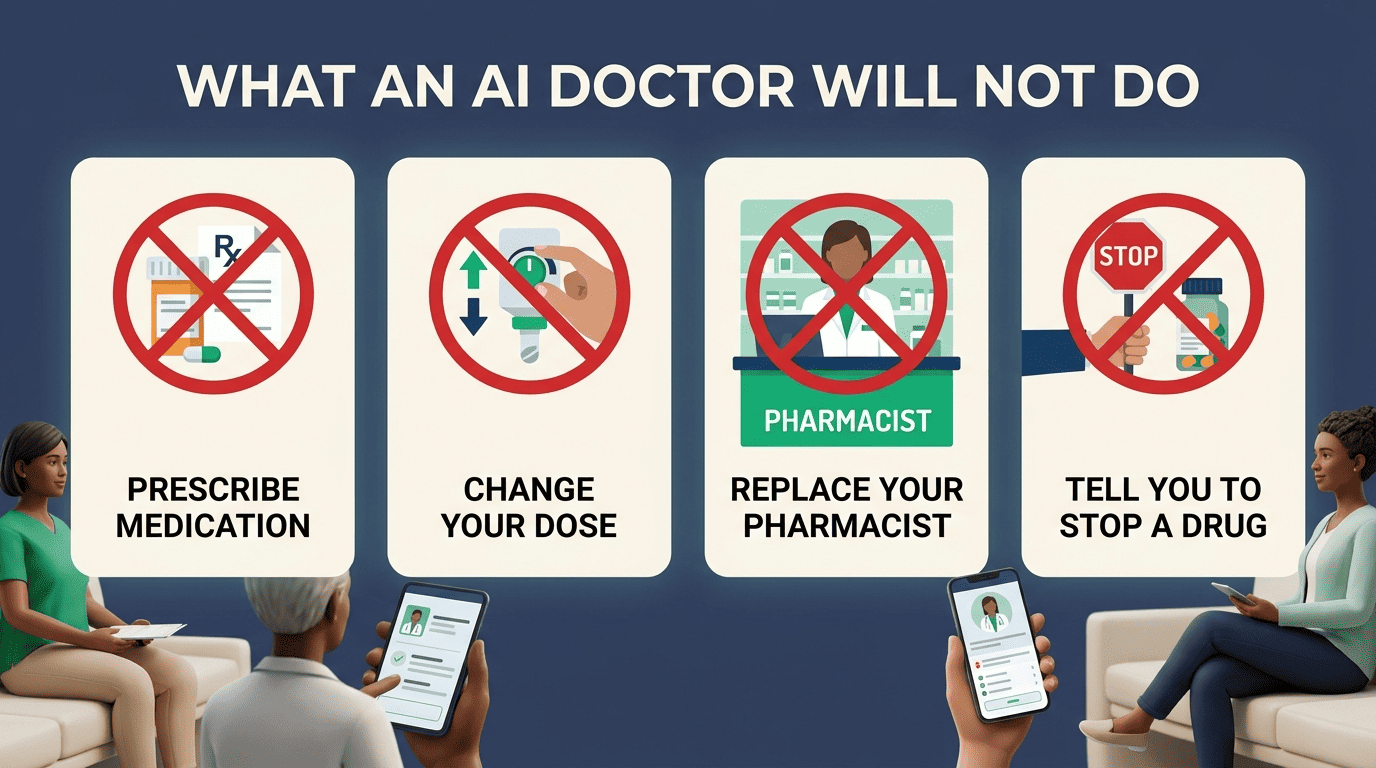
Never stop or start a medication because an AI told you to. Stopping certain drugs abruptly can be dangerous or even life-threatening, including:
- Blood thinners (risk of clotting or bleeding rebound)
- Antidepressants (withdrawal effects)
- Corticosteroids (adrenal suppression)
- Seizure medications (risk of seizure recurrence)
Treat anything an AI medical assistant tells you as a prompt to call your prescriber or pharmacist, never as an instruction to act on your own.
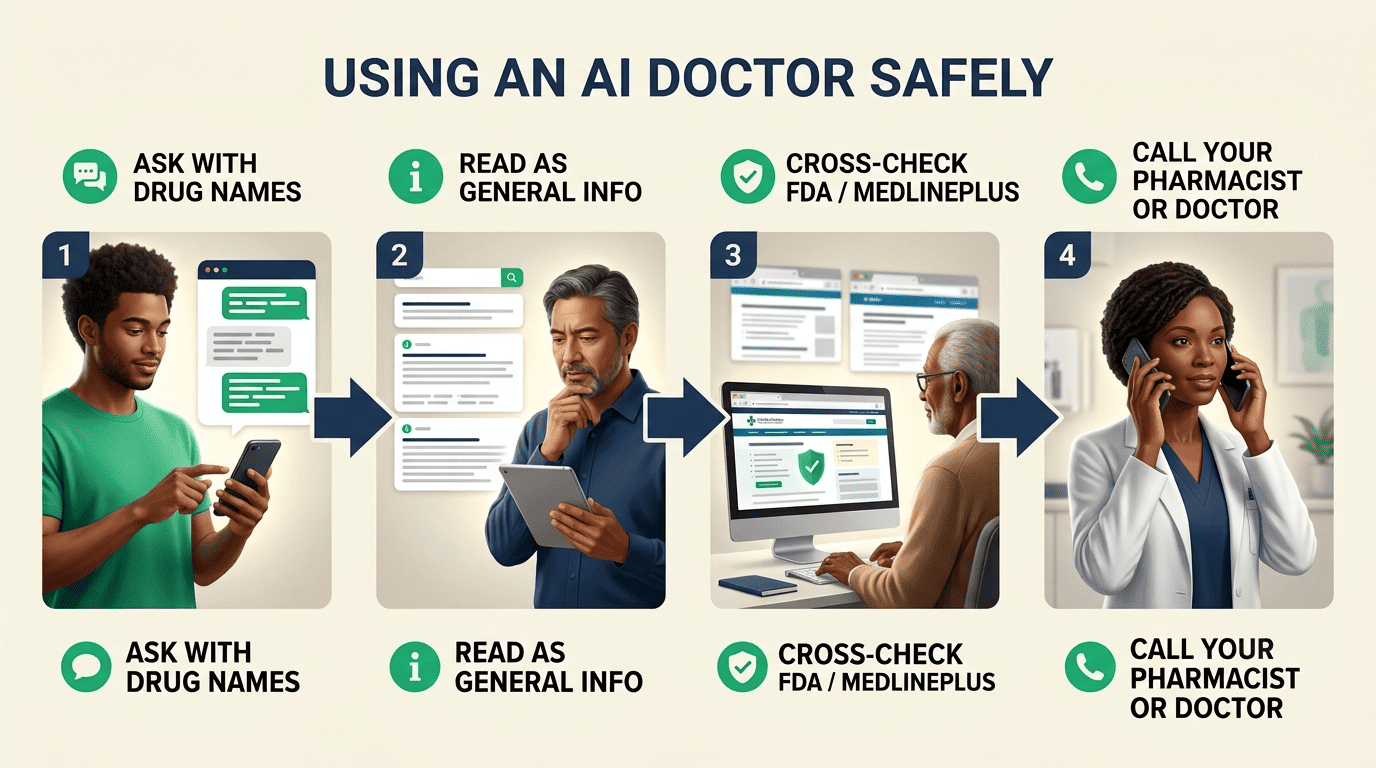
Knowing who to contact — and when — matters as much as knowing what to ask:
| Situation | Who to contact |
|---|---|
| General question about what a medication does | AI doctor, then your pharmacist to confirm |
| Non-urgent side effect or interaction question | Pharmacist (free, no appointment needed) |
| New prescription or dose change | Licensed physician |
| Suspected poisoning or overdose | Poison Control: 1-800-222-1222 |
| Mental-health crisis | Call or text 988 |
| Life-threatening emergency | 911 |
A short mental checklist for using an AI doctor responsibly:
- Ask your question with specific drug names and doses.
- Read the answer as general information, not a diagnosis.
- Cross-check anything important against MedlinePlus or DailyMed.
- Write down what you don’t understand.
- Call your pharmacist or physician before changing anything.
- In an emergency, skip the chatbot and call 911 or Poison Control.
- Never treat an AI summary as a prescription or medical order.
Turn AI Answers Into Better Questions for Your Doctor or Pharmacist
The pharmacist is your most accessible medication expert
Pharmacists are experts specifically on medications and how they interact — and unlike a physician visit, a consultation at the counter is typically free and doesn’t require an appointment. If an AI medication assistant has already summarized what a drug does and flagged possible interactions to ask about, bring that summary straight to the pharmacy counter and let the pharmacist confirm it against your actual chart.
A ready-to-use question checklist
Walk into any appointment or pharmacy visit with these ready:
- What is this medication for, exactly?
- How and when should I take it?
- Which side effects are normal, and which mean I should call right away?
- Does it interact with my other medications, supplements, alcohol, or specific foods?
- What should I do if I miss a dose?
- How long until I notice it working?
- Is this safe alongside my existing conditions?
An AI doctor chat can help you draft that list in minutes before your appointment even starts, so the conversation with your pharmacist or physician goes further in less time.