
Can an AI Doctor Read Your Lab Results? What It Can (and Can’t) Do
Yes — a modern ai doctor can read your lab results. It pulls out each value from your report, lines it up against the lab’s reference range, and explains in plain language what an «H» or «L» flag actually means. According to MedlinePlus, part of the National Library of Medicine, understanding what those numbers mean is exactly the kind of task an AI assistant is built to help with.

But reading a report is not the same as diagnosing you. An AI doctor turns confusing numbers into plain English; deciding what to do about those numbers is still the job of a licensed physician. The rest of this article walks through how AI actually reads a lab report, what «out of range» really means, how accurate this technology is, and where the line sits between a helpful explanation and a decision only a clinician should make.
Medical disclaimer: This article is for general education only. It is not medical advice and not a substitute for a licensed physician. An AI doctor can explain lab results but cannot diagnose or treat you. If you have a medical emergency, call 911 (US). If you are in a mental-health crisis or thinking about suicide, call or text 988 (988 Suicide & Crisis Lifeline).
doctorai.company editorial team
Yes — an AI Doctor Can Read Lab Results (Here’s What That Means)
An AI assistant built on a large language model — the technology behind ChatGPT, Claude, and Gemini — can extract every biomarker on a lab report, match it to the standard reference range printed next to it, and label each one normal, high, or low. That is the core job of an AI lab result analyzer: turn a dense PDF full of abbreviations into something you can actually understand. Most tools accept a PDF upload, a photo of the printed report, or values typed in by hand, and return a plain-language summary within seconds.
What «reading» a lab report actually looks like
In practice, an AI blood test interpreter recognizes the common panels — a complete blood count (CBC), a metabolic panel, a lipid panel, thyroid-stimulating hormone (TSH), and hemoglobin A1c — and reads each result alongside the reference range your specific lab printed on the report. It then flags the status (normal, high, or low) and explains, in a sentence or two, what that biomarker generally measures. A platelet count flagged low, for example, gets translated into something like «platelets help your blood clot; a low count means fewer of these cells were counted than the typical range for this lab.» The explanation is general — it does not weigh your personal history, medications, or symptoms unless you provide them.
Read vs interpret vs diagnose — three different things
It helps to separate three verbs that get blended together. «Read» means extracting the numbers and reading them back to you correctly. «Interpret» means explaining, in general terms, what a given biomarker measures and what an out-of-range flag typically indicates. «Diagnose» means naming a specific medical condition and recommending treatment based on your complete case. An ai doctor lab results tool is confident and useful at the first two. It is not designed, and should not be trusted, to do the third — that step belongs to a clinician who has your full history in front of them.
How an AI Doctor Reads a Lab Report: Values vs Reference Range
Every number on a lab report is meaningless without something to compare it to. That’s what a reference range does — and understanding how it’s built is the key to reading any lab report correctly, whether a human or an AI is doing the reading.
What a reference range is (and why «normal» isn’t a hard line)
A reference range is a statistical interval built to include roughly 95% of healthy people: the middle 95% of measured values, with about 2.5% falling below the range and 2.5% falling above it. That design has a direct consequence — roughly 1 in 20 perfectly healthy people will land outside the «normal» range on any given test, simply because of how the range is calculated, not because something is wrong with them. Reference ranges also differ between labs, testing methods, age groups, and sexes, which is why an H or L flag only makes sense read alongside the range printed on that same report.
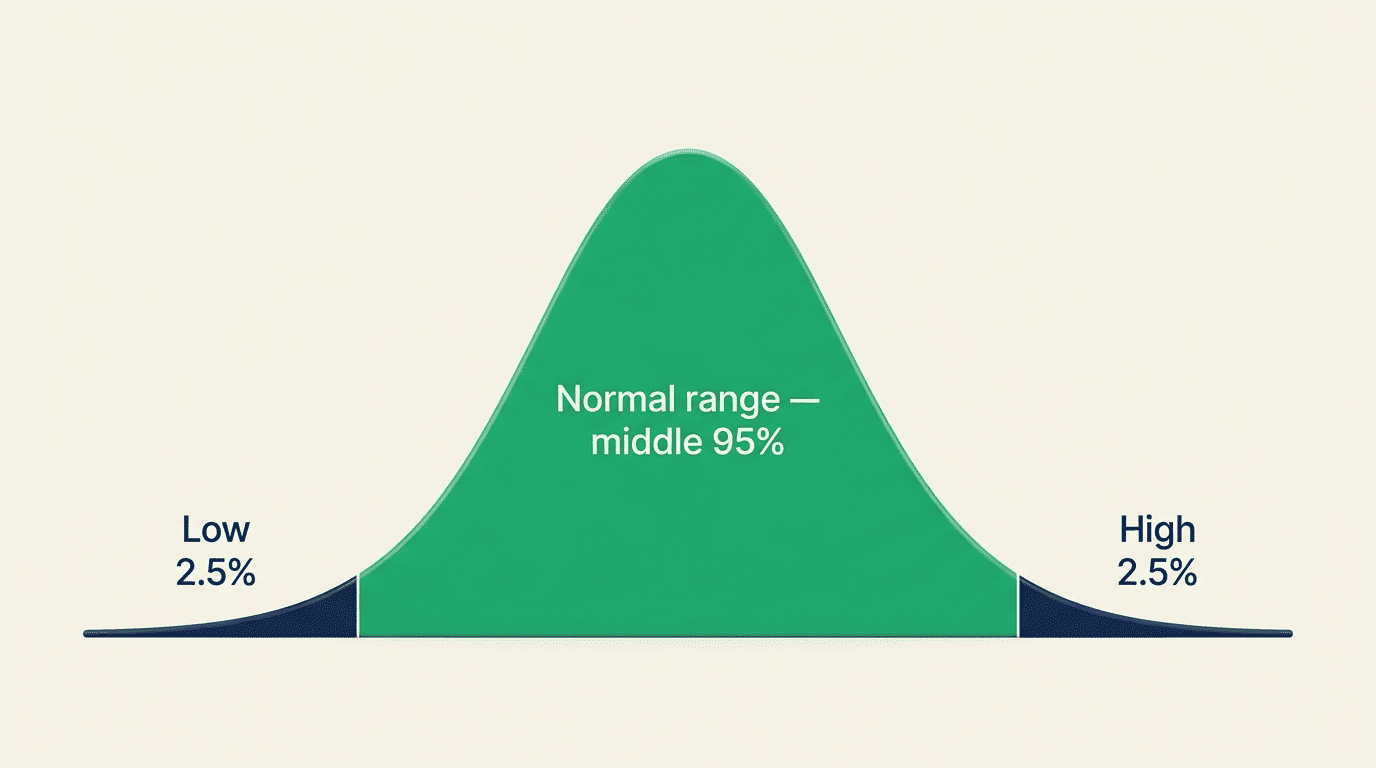
What the H and L flags mean
H means the value sits above the top of the reference range; L means it falls below the bottom. A flag is a signal to look closer, not a verdict. Where AI genuinely helps is speed: it can scan a multi-page report, pull out every flagged line at once, and explain in plain terms what each flagged biomarker is generally responsible for in the body.
| Flag | Meaning | What it signals |
|---|---|---|
| Normal | Value falls inside the reference range | No flag raised; still worth tracking over time |
| H (High) | Value is above the top of the range | Worth a closer look, not automatically a problem |
| L (Low) | Value is below the bottom of the range | Worth a closer look, not automatically a problem |
| Critical | Value is far outside the range | Lab typically alerts the ordering physician directly |
What «Out of Range» Really Means — and What It Doesn’t
An out-of-range flag is often the most anxiety-provoking part of a lab report, and it’s also the part most likely to be misread.
One value out of range is usually not an emergency
MedlinePlus states it directly:
A test result that is higher or lower than the range that applies to you may or may not be a sign of a health problem.
MedlinePlus, National Library of Medicine
There are several ordinary, non-alarming reasons a single value can land outside the range: dehydration, a recent meal or workout, certain medications, or simple day-to-day lab variability. An AI assistant can list these possible explanations for you, but it has no way of knowing which one actually applies to you — it doesn’t know whether you skipped breakfast or just finished a run.
When out of range does matter: trends and critical values
A single flagged value usually matters less than a trend over time or a combination of several flagged values pointing in the same direction. A critical value — a result far enough outside the range to be dangerous — is typically escalated by the lab directly to the ordering physician, often the same day. If you want to see how a doctor ai tool can help you track values like these over multiple test dates, that pattern-spotting is one of the more genuinely useful parts of the technology — as long as any concerning trend still goes to a clinician for a real read.
How Accurate Is an AI Doctor at Reading Labs?
Accuracy claims in this space are all over the place, and a lot of them are marketing, not evidence.
Good at plain-language explanations, weak at your full picture
AI is genuinely strong at translating jargon, explaining what a biomarker generally measures, and helping you prepare specific questions for your doctor. It is comparatively weak at judging results in the context of your full medical picture. A 2024 study in Nature Medicine by Hager and colleagues found that large language models do not reliably interpret lab data without clinical oversight and do not match physician-level performance on that task.
AI can be confidently wrong
Language models can hallucinate — stating something invented as if it were fact — and can over- or under-emphasize a finding without meaning to. In one documented case reported by the Associated Press, OpenAI’s Whisper transcription tool inserted a fabricated medical treatment into a transcript that was never actually said. A 2024 KFF poll found that 56% of people who use AI chatbots are not confident the answers they get are accurate. The practical takeaway: treat an AI explanation as a starting point to verify, not a final answer to act on.
| Strength | Limitation |
|---|---|
| Explains medical jargon in plain language | Doesn’t reliably interpret results against your full history |
| Spots and lists every flagged value quickly | Can hallucinate or fabricate details |
| Helps you prepare questions for your doctor | Not held to physician-level accuracy standards |
| Available any time, no appointment needed | Cannot examine you or order follow-up testing |
What an AI Doctor Won’t Do — and When to See a Clinician
Even in settings where AI is already part of clinical workflows, a human stays firmly in charge of the final decision.
The line: AI explains, a clinician decides
AI explains — a clinician decides and treats. That distinction holds even inside real hospital systems. Stanford Medicine reports that Stanford Health Care uses an AI tool, built on Anthropic’s Claude 3.5 Sonnet, to draft plain-language interpretations of lab results for patients — but a physician reviews and approves every draft before it is sent. The pilot started with 10 physicians for one month and expanded to 24 physicians for a second month, precisely because the tool was designed to assist doctors, not replace their judgment.

Every abnormal or critical result still needs a clinician’s context. A physician interprets a flagged value alongside your age, sex, medications, symptoms, and history — context that an AI doctor simply does not have unless you supply it, and even then can’t weigh the way a trained clinician can.
A formal diagnosis requires a license, not a model. No AI system, no matter how capable, is a substitute for the judgment of a licensed physician who can examine you, order further testing, and take responsibility for your care.
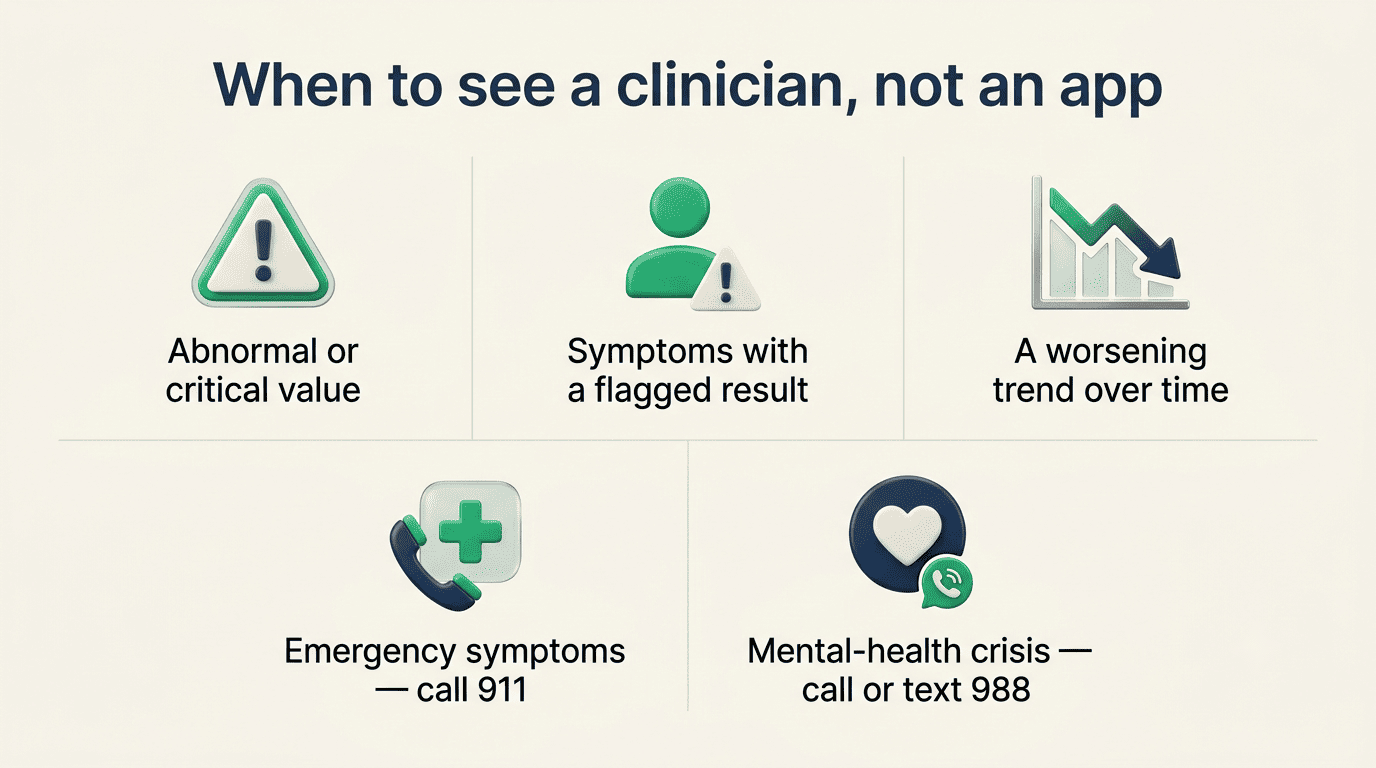
Red flags: don’t wait on an app
- Any abnormal or critical lab value — bring it to a clinician, don’t just read the AI’s explanation and move on
- Symptoms paired with a flagged lab result (pain, unusual fatigue, unexplained weight change)
- A worsening trend across several tests, even if no single value looks alarming
- Emergency symptoms such as chest pain, difficulty breathing, or confusion — call 911 immediately
- Thoughts of suicide or a mental-health crisis — call or text 988 (988 Suicide & Crisis Lifeline)
As a reminder: an AI doctor can explain what a lab report says. It cannot examine you, order more tests, or take responsibility for treating you — that is what a licensed physician is for.
Is It Private and Safe to Upload Lab Results to AI?
Before you paste anything into a chatbot, it’s worth knowing where that data actually goes.
Strip identifiers before you paste
Data typed or uploaded into a consumer AI chatbot generally goes to the technology company running that service, and most consumer-facing chatbots are not required to comply with HIPAA or a comparable federal health-privacy law, according to reporting from NPR. OpenAI CEO Sam Altman has publicly cautioned users against putting sensitive personal information into ChatGPT for exactly this reason. Purpose-built medical AI services may state HIPAA or SOC 2 compliance, but that claim is worth checking in their actual privacy policy rather than assuming it.
Before uploading a lab report anywhere:
- Remove your full name
- Remove your date of birth
- Remove your Social Security number
- Remove any patient ID or medical record number
- Keep only the biomarker names, values, and reference ranges
How to Use an AI Doctor for Lab Results the Right Way
Used carefully, an AI assistant can make a confusing lab report much easier to act on.
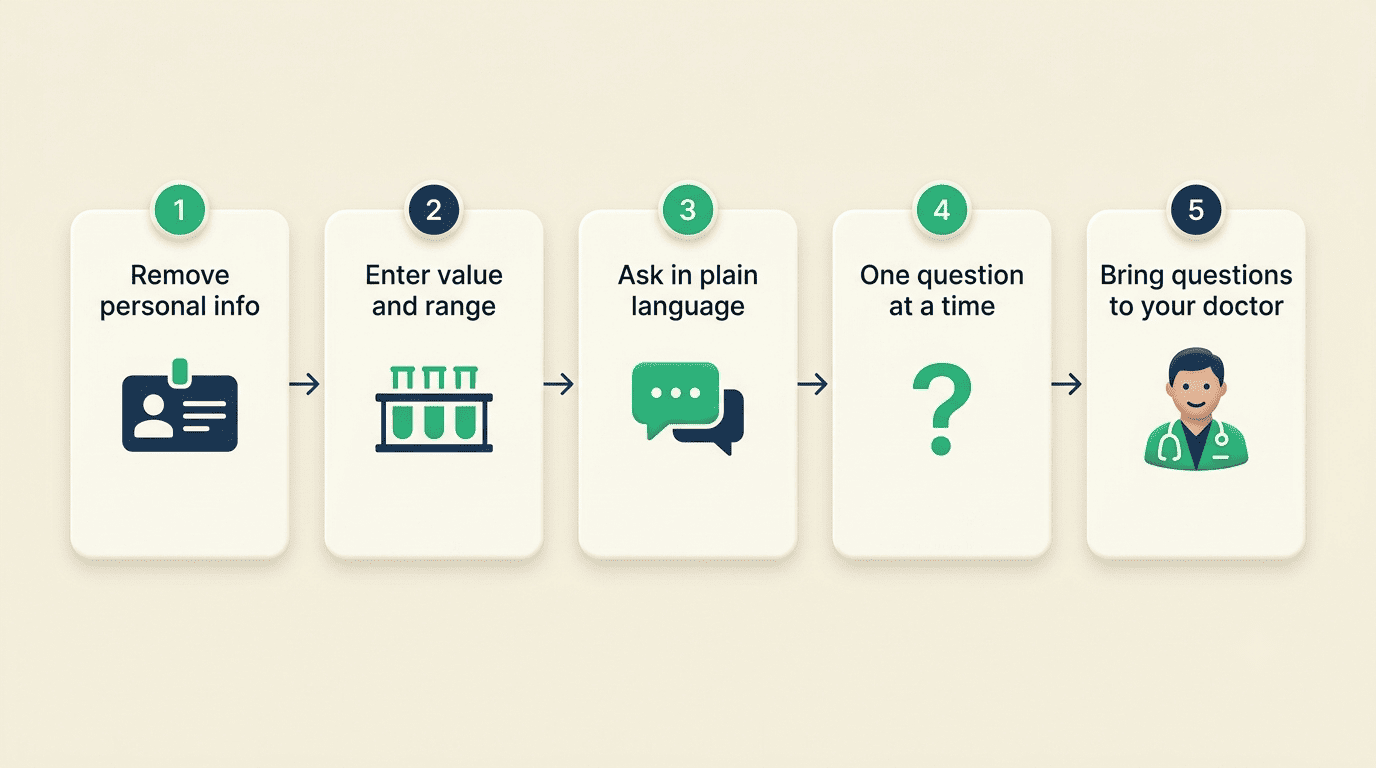
A simple, safe workflow
- Remove personal identifiers from the report before uploading or typing anything in
- Paste in the biomarker name, your value, and the reference range printed next to it
- Ask the AI to explain the result in plain language and list what’s worth discussing with your doctor
- Ask one focused question at a time rather than a broad «what’s wrong with me»
- Ask for a reliable source, such as MedlinePlus, to cross-check the explanation
- Bring your questions — not conclusions — to your doctor’s visit
Framing the request carefully measurably improves the quality of the response: asking the AI to answer as a clinician would, and asking one question per exchange rather than several at once, has been shown in early proof-of-concept work described by KFF and NPR to produce more careful, accurate answers than an open-ended prompt.