
Can an AI Doctor Explain Your Diagnosis? What It Can (and Can’t) Do
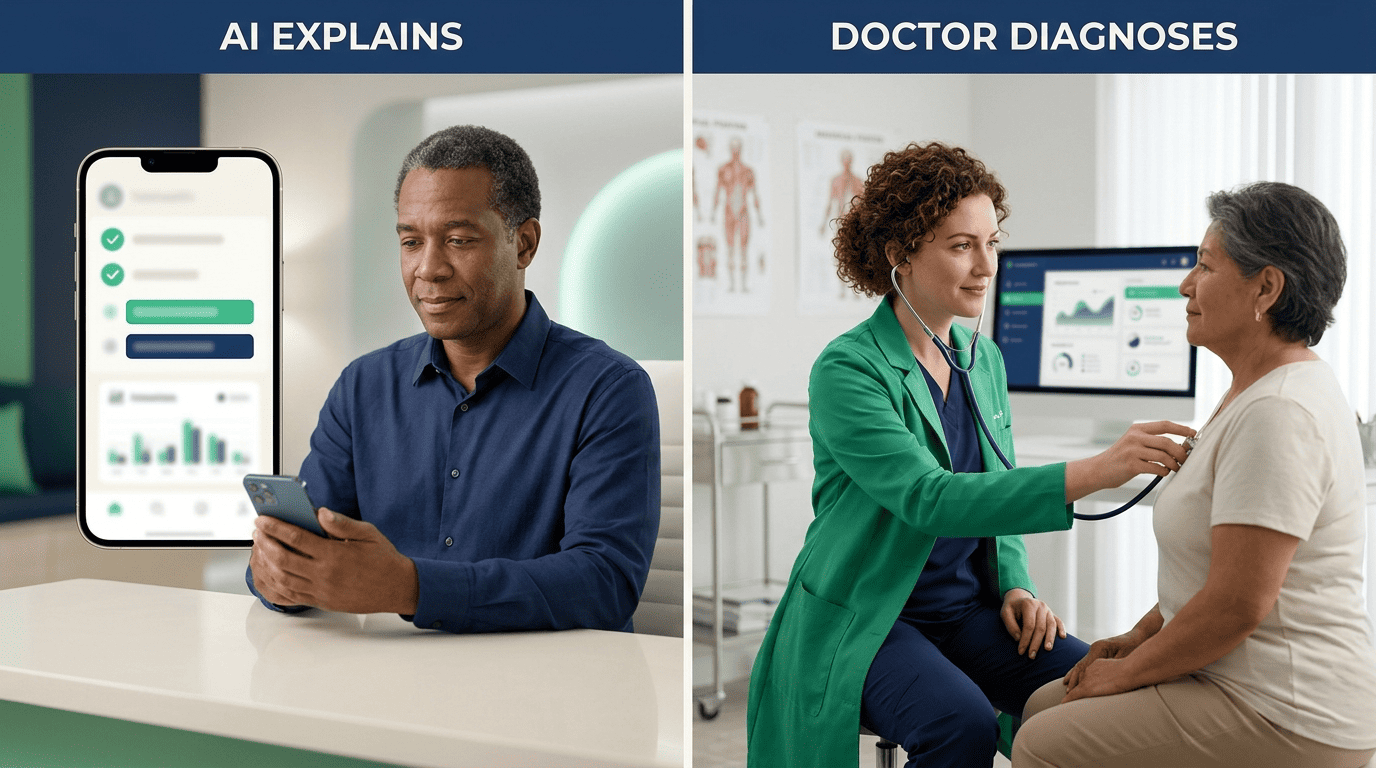
Yes — an ai doctor can take a diagnosis, lab result, or pathology report your physician already gave you and translate it into plain language in seconds. The key distinction is what it’s built to do: it explains a diagnosis you already have, according to MedlinePlus, the National Institutes of Health’s plain-language health encyclopedia, which is also a good place to double-check any term an AI tool gives you. It does not examine you, run tests, or hand down a new diagnosis of its own.

This article covers how that translation actually works, where the accuracy breaks down, what questions to prepare for your next appointment, whether it’s safe to paste your results into a chatbot, and exactly when to stop typing and pick up the phone instead.
This article is for general information only and is not medical advice or a substitute for a licensed physician. Always confirm any AI explanation with your doctor. If you have a medical emergency, call 911. If you are in a mental-health crisis, call or text 988 (Suicide & Crisis Lifeline).
What «an AI doctor explaining your diagnosis» actually means
An AI doctor, in this context, is a large language model — the technology behind tools like ChatGPT and Claude — used as an AI medical assistant that rewrites a diagnosis or test result in everyday words. About a third of US adults have already turned to an LLM for medical information, often because they’re staring at a result before anyone has explained it to them. Under the 21st Century Cures Act, patients typically see lab and imaging results appear in their online portal before a clinician calls to walk through what they mean, which is exactly the gap an AI-powered doctor-to-patient translator is built to fill. The HHS.gov guidance on the right to access records confirms that patients are legally entitled to see this information as soon as it’s finalized — the question is simply whether they can understand it once it arrives.
Explaining vs diagnosing — the line that matters
Can an AI doctor diagnose your condition? No. What it does is take information that already exists — a report a pathologist signed, a value a lab measured — and restate it in language a non-specialist can follow, along with possible explanations of what that finding generally means. A formal diagnosis still requires a licensed physician who has examined you, reviewed your full history, and can be held professionally accountable for the call. Treat an AI doctor as a translator sitting between you and a dense document, not as a replacement for the person who signed it.
Why so many people need this now
The gap between «seeing your results» and «understanding your results» is wider than most people expect. In one University of Michigan study, only 39% of prostate cancer patients understood the basics of their own pathology report after reading it on their own. Part of the problem is time: primary care visits in some health systems run as short as 7 to 10 minutes, which leaves little room for a physician to unpack unfamiliar terminology line by line. Combine that with same-day portal access to results, and it’s easy to end up staring at a term like «hypodense nodule» alone at home, hours before anyone can explain what it means.
How AI turns medical jargon into plain English
The core function of a plain-language medical summary tool comes down to a few concrete moves:
- Swaps clinical vocabulary for everyday words
- Spells out abbreviations you weren’t given the key to
- Structures the result into what the finding is, what it generally means, and what tends to happen next
- Flags the parts of the report worth asking your doctor about directly
| Original medical language | Plain-language AI translation |
|---|---|
| «Hypodense nodule, 6 x 2.9 x 4 cm» | A soft, small growth about the size of a large grape |
| «Gleason score 3+4» | A prostate cancer grading pattern that’s mostly low-grade with some intermediate-grade cells mixed in |
| «No evidence of malignancy» | No signs of cancer were found in this sample |
| «Elevated ALT/AST» | Two liver enzymes are higher than the typical reference range |
From portal jargon to a sentence you understand
A well-built ai doctor diagnosis tool doesn’t just swap words — it restructures the whole report into a sequence a patient can actually follow: what the diagnosis is, what it means in practice, and what the reasonable next steps tend to be. One patient-facing tool, Medsplain, turned «hypodense nodule 6×2.9×4 cm» into «a soft, small growth about the size of a large grape» — concrete, visual, and immediately understandable without a medical dictionary open in another tab.
The measurable jump in understanding
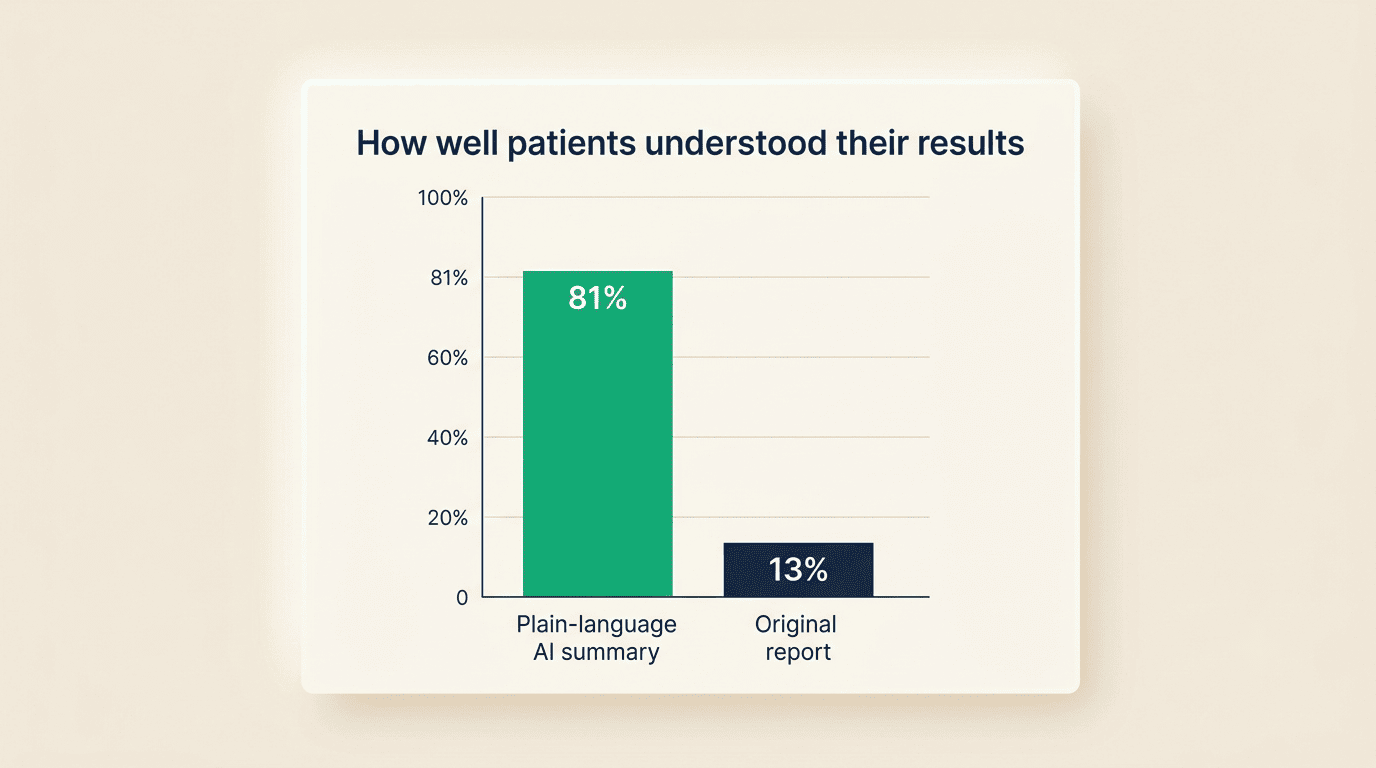
The improvement isn’t just anecdotal. Researchers led by Zaretsky and colleagues found that AI-generated summaries of hospital discharge notes came out at roughly a 6th-grade reading level, compared with an 11th-grade level in the original clinical text — and patient comprehension of those summaries jumped from about 13% to 81%, a figure cited in a randomized-trial protocol published via the National Institutes of Health that is now testing the same approach in real clinics. Another plain-language tool, Vital, brought reports down to a 5th-grade reading level, and a separate evaluation of Patiently AI found its summaries were rated 4.49 out of 5 for medical accuracy while reading nearly 3 grade levels easier (2.96, on the Flesch-Kincaid scale) than the source document. That combination — easier to read without losing the substance — is precisely what makes AI useful for explanation rather than decision-making.
Where AI gets it wrong — accuracy, hallucinations, and real risk
No plain-language tool is immune to getting details wrong, and understanding exactly where that happens matters more than the reassuring statistics above.
Hallucination is not rare
In the Zaretsky study, 18 out of 100 AI-generated summaries contained missing or inaccurate information — not a rounding error, but a real, recurring failure mode. A separate analysis published in Nature Medicine found that when patients used an LLM together with their own symptom description to reach a conclusion, the pairing landed on the correct answer only around a third of the time. AI output can contain missing or inaccurate information even when it reads confidently. That’s why a human — specifically, the physician who ordered the test — needs to stay in the loop on anything that affects a real decision.
The stakes are real
Claude is not designed or marketed for making clinical diagnoses… helping people prepare for conversations with their doctors, not replacing them.
Anthropic, via Scientific American
The consequences of skipping that step can be severe. Scientific American reported on a 75-year-old man in the Seattle area who died from a treatable form of leukemia after declining treatment based on inaccurate AI-generated advice. That case is the clearest possible illustration of the boundary this article keeps returning to: use an AI doctor to understand your diagnosis and prepare sharper questions, not to decide your treatment in place of the physician who’s actually accountable for it.
Using an AI doctor to prepare for your appointment
Once you understand what a diagnosis means, the next useful step is turning that understanding into a short list of questions worth asking out loud.
Turn your diagnosis into a smart question list
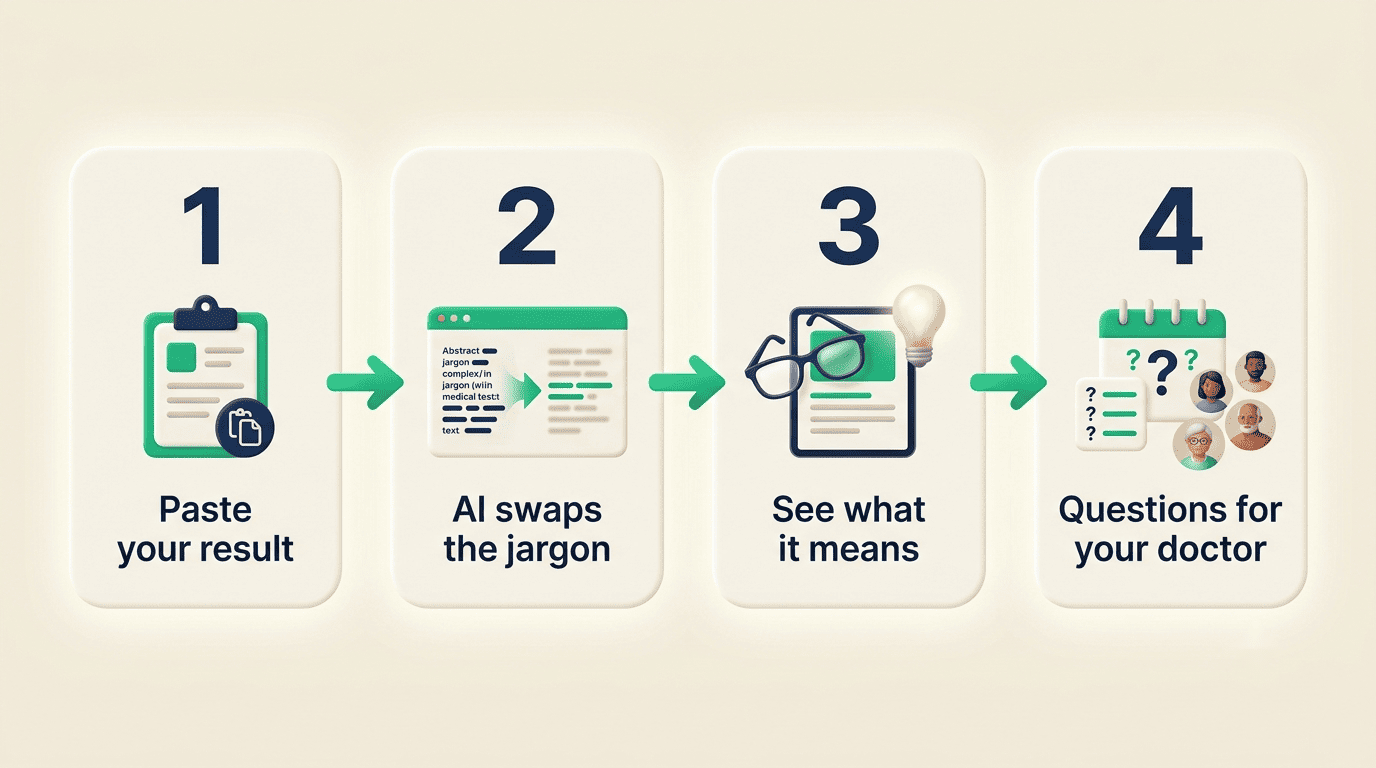
A practical, repeatable step-by-step approach:
- Paste or describe the diagnosis, lab value, or report language you don’t understand.
- Ask the AI doctor to explain the term itself in plain English first, before anything else.
- Ask it to list what typically causes or is associated with that finding.
- Ask it what a doctor would usually check or ask next given that result.
- Ask it to flag anything in the report that sounds like it needs urgent follow-up.
- Write down the three questions that matter most to you specifically.
- Bring that list — not the AI’s full answer — to your appointment.
One tool built for this purpose, Osler — a chatbot on MyPathologyReport.com — answers a patient’s plain-language questions about their pathology report, drawing on articles written by pathologists, and will ask for clarification rather than guess. That’s the model worth copying even if you’re using a general-purpose doctor ai: use it to turn confusion into specific questions, and let your physician answer them.
Bring it back to a human
Used appropriately, large language models are one of the most powerful tools ever built for patient empowerment, according to physician commentary in Scientific American — but «used appropriately» is doing real work in that sentence. It means using the AI to prepare, not to conclude. Second opinions matter here too: pathologists reviewing prostate biopsies change the Gleason grade in roughly 20% of second-look cases, which is itself a good reason to ask your doctor whether a second opinion makes sense for anything significant. That’s shared decision-making — you arrive informed, your physician supplies the judgment and accountability.
Is it safe to paste your medical results into AI?
Privacy is a separate question from accuracy, and it deserves its own checklist before you copy a report into any chat window.
- Purpose-built medical AI tools tend to be more careful. Medsplain, for example, states it does not retain data long-term, uses end-to-end handling, and does not use patient input to train its models.
- Some tools go further on privacy engineering. Patiently AI edits out personally identifying information on-device, does not store the underlying report, and sets any shareable link to expire after 90 days, citing GDPR and ICO compliance.
- General-purpose chatbots are the biggest unknown. A consumer AI assistant not built specifically for health data isn’t automatically bound by HIPAA the way your doctor’s own systems are — protection depends on that product’s own privacy policy, not on the fact that you’re discussing something medical.
What to check before you paste
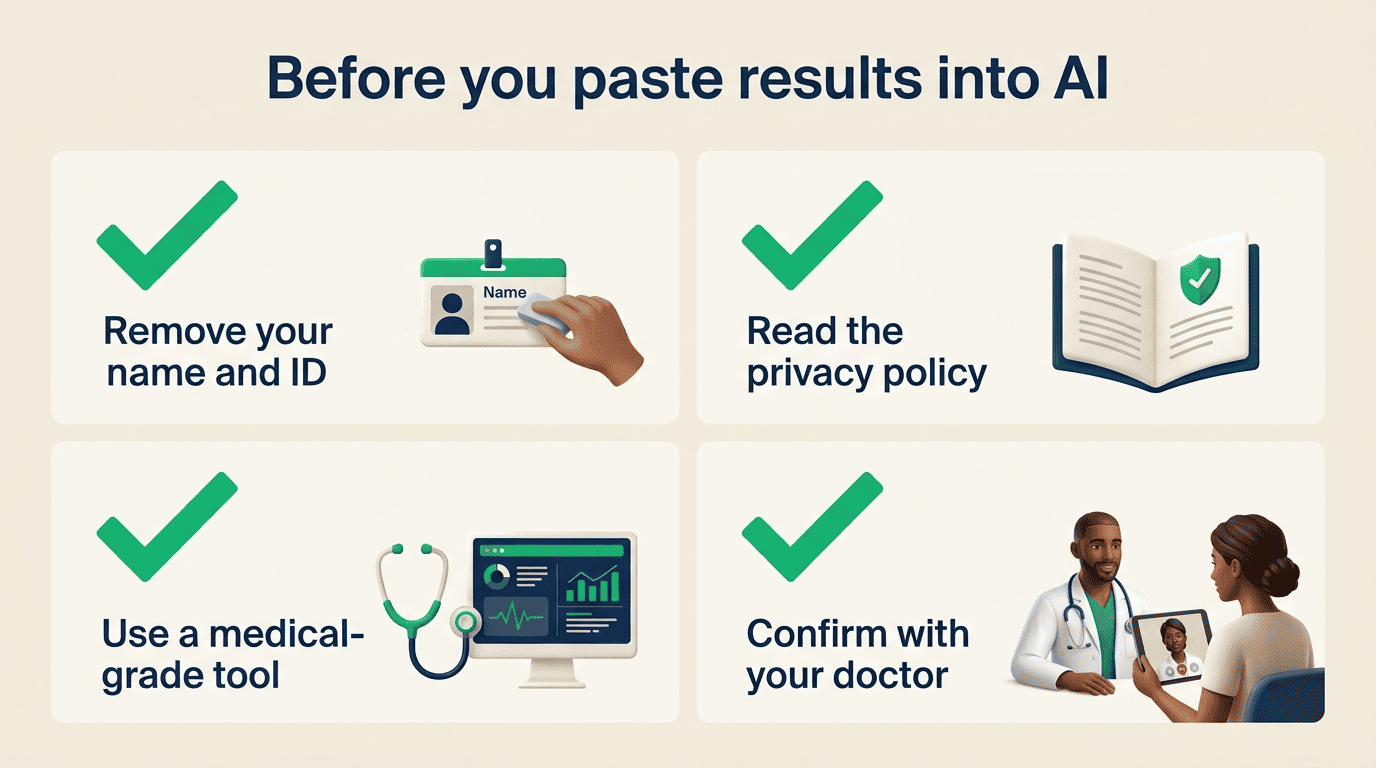
Before you paste a report into any AI tool:
- Strip out your name and any patient ID if the interface allows it
- Actually read the privacy policy rather than assuming one applies
- Lean toward tools built specifically for medical documents, with an explicit disclaimer, over general-purpose chat products
- Avoid uploading your full chart when a single term or paragraph is all you need explained
Specialized tools that edit out identifying information and don’t train on your data are a meaningfully safer choice than a generic assistant with no stated health-data policy at all.
When NOT to rely on AI — red flags and emergencies
An AI doctor cannot examine you, cannot order tests, and cannot write a prescription — it works from the words you type, nothing more. That limitation turns into real danger the moment a symptom is time-sensitive.

Skip the chatbot and call 911 immediately if you notice any of the following:
- Chest pain or pressure
- Trouble breathing
- Sudden weakness, numbness, or slurred speech — signs of stroke, often remembered as F.A.S.T. (Face, Arms, Speech, Time)
- Severe or uncontrolled bleeding
- Any sudden, severe, or rapidly worsening symptom
If you or someone you know is having thoughts of suicide or self-harm, call or text 988, the Suicide & Crisis Lifeline, right away — you can also read more about how that service works at 988lifeline.org. These two numbers, 911 and 988, matter more than anything else in this article, and no AI explanation is worth delaying either call.
| Situation | What to do |
|---|---|
| You want to understand a term in your diagnosis or lab report | Ask an AI doctor, then confirm with your physician |
| You’re drafting questions for an upcoming appointment | Ask an AI doctor to help you prepare a list |
| Chest pain, trouble breathing, stroke signs, severe bleeding | Call 911 — skip the chatbot entirely |
| Thoughts of suicide or self-harm | Call or text 988, the Suicide & Crisis Lifeline |
| You need a new diagnosis, a prescription, or a treatment decision | See a licensed physician — an AI doctor cannot provide this |